
01 //Academy
- Coding
- AI
- Robotics
- Games
- Languages
Where curious minds aim high.
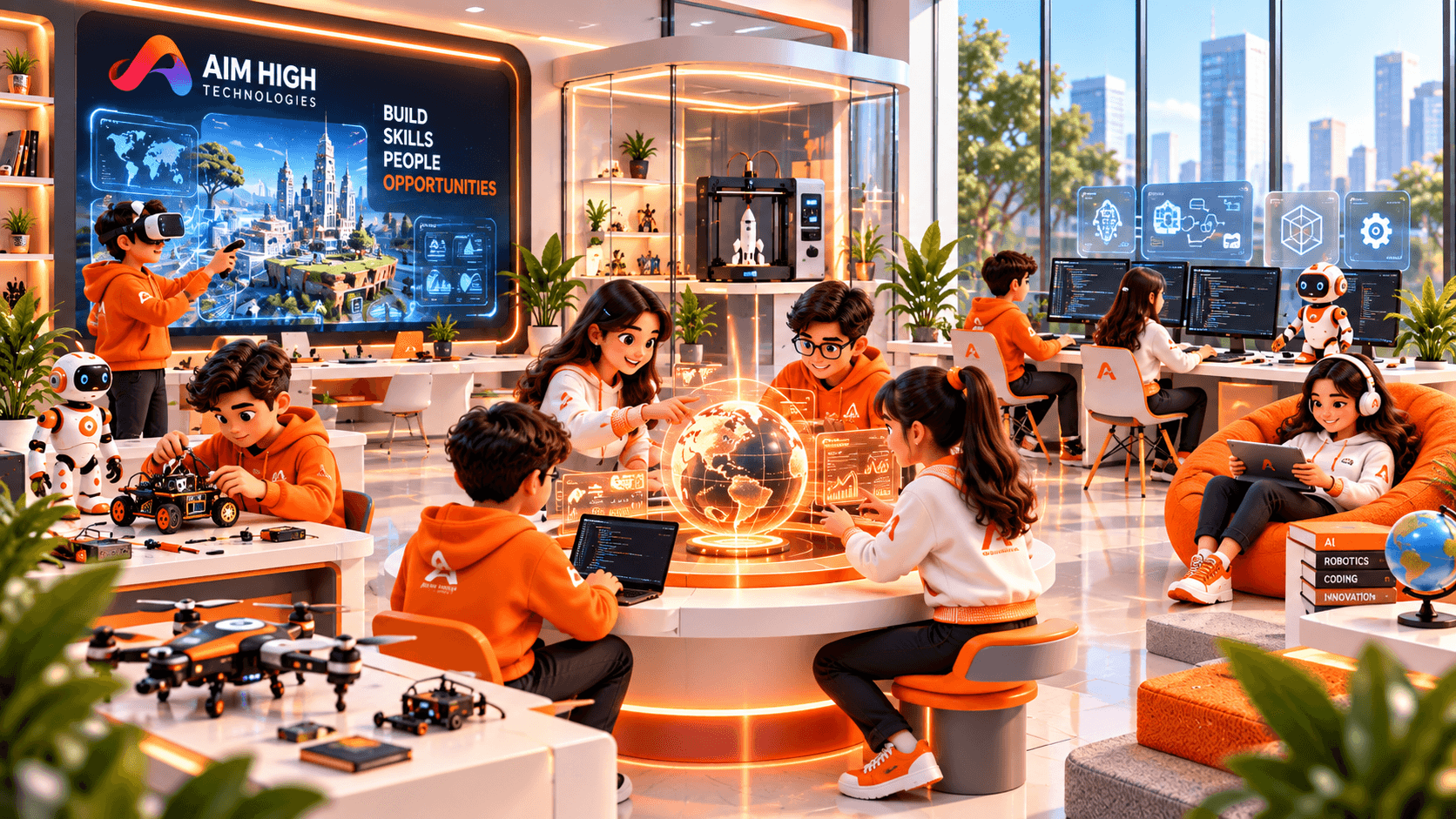
A learning environment for younger minds, built around making things: code that runs, machines that respond, games that play and languages spoken with confidence.
02 //Why the Academy
Not more screen time. Making time.
The Academy applies the way technology is actually practised at AIM HIGH to how younger learners are taught: they build from the first session rather than watch.
- 01Creation
Making, not watching
Learners write code, wire a circuit, shape a game or tell a story. The work is theirs, and it runs.
- 02Guidance
Taught, not left to a video
Sessions are led, questions get answered, and a learner who is stuck is helped rather than skipped past.
- 03Balance
Technology and heritage together
Computing and language sit side by side here, because fluency in both shapes how a young person sees the world.
- 04Evidence
Something to show for it
Each path ends in work a learner can demonstrate and explain, which is a better measure than a score.
03 //Learning paths
Six ways to explore.
Four technology paths and two language paths, each one a place to start rather than a ladder to climb in order.
- 01Logic, problem solving and building
Coding
Computational logic, from visual block programming into Scratch and Python.
- Why it matters
- Once a learner can describe a problem in steps, every other technology path opens up.
- 02How machines learn, and where they fail
AI
Hands-on introductions to machine learning, with the reasoning and the limits made visible.
- Why it matters
- Learners will grow up alongside these tools, so understanding them beats being impressed by them.
- 03Sensors, motors and physical logic
Robotics
Building and programming devices that sense their surroundings and respond.
- Why it matters
- Working with real hardware teaches patience and precision that a screen alone does not.
- 04Interactive design, rules and creative logic
Game Development
Designing and building playable games, from the idea through to something others can try.
- Why it matters
- Games make abstract programming ideas immediate, because the result can be played.
- 05Speaking, script, reading and stories
Telugu
Structured Telugu learning: conversation, Varnamala script, reading and storytelling.
- Why it matters
- For many families this is how a child stays connected to relatives, culture and home.
- 06Conversation, Devanagari, reading and expression
Hindi
Structured Hindi learning: grammar foundations, vocabulary, script and storytelling.
- Why it matters
- A language a learner can actually speak opens conversations that translation cannot.
04 //Coding
Ideas that turn into instructions.
Coding starts with logic a learner can see and moves into written code, so the step from blocks to a real language feels like the next sentence rather than a new subject.
See the full pathLogic and sequence
Putting steps in the right order, and finding the one that is out of place.
Problem solving
Breaking something big into parts small enough to solve one at a time.
Programming
Moving from block-based building into written code, with the ideas carried across.
Creating
Making something that runs: a sketch, a tool, a small program of a learner's own.
05 //AI
How machines learn.
AI is explored by using it and taking it apart: training something simple, seeing where it gets things wrong, and asking why.
See the full pathHow a model learns
Showing a computer examples, then seeing what it does with something new.
Training something simple
Building a small model from a learner's own examples and testing it honestly.
Where it goes wrong
Looking at mistakes and bias in what a model learned, and where the examples came from.
Using AI thoughtfully
When a tool helps, when it misleads, and why the answer still needs checking.
06 //Robotics
Code that moves something.
Robotics connects a program to the physical world, where a mistake is visible immediately: the motor turns the wrong way, or the sensor reads nothing at all.
See the full pathSensing the world
Reading distance, light, movement or sound, and turning that into a number a program can use.
Making things move
Driving motors and mechanisms, and getting the timing right.
Circuits and connections
Wiring components carefully and understanding what each part is doing.
Testing and fixing
Finding out why a build misbehaves, changing one thing, and trying again.
07 //Game development
From playing games to building them.
Game development turns a familiar pastime into a design problem: rules, movement, difficulty and feedback all have to be decided by the person making it.
See the full pathDesign and rules
Deciding what the player can do, what stops them, and what makes it fun.
Movement and physics
Jumping, collisions and speed, and the logic underneath them.
Levels and challenge
Shaping difficulty so a game stays interesting without becoming discouraging.
Playtesting
Watching someone else play, listening, and changing the game because of it.
08 //Telugu
A language that stays in the family.
Telugu is taught as a living language: speaking first, then reading and writing the script, with the stories and traditions that carry it.
See the full pathSpeaking
Everyday conversation, so the language is used rather than studied.
Script and reading
Learning Varnamala and building towards reading with understanding.
Writing
Forming letters and words, then sentences a learner composes themselves.
Stories and traditions
Folk tales and cultural context that give the words somewhere to live.
09 //Hindi
Confidence in a widely spoken language.
Hindi is built from spoken confidence outward: conversation, then Devanagari script, then reading and expression.
See the full pathSpeaking
Conversation practice that builds the confidence to start talking.
Devanagari script
Reading and writing the script, letter by letter into whole words.
Grammar and vocabulary
The structure that turns remembered words into sentences of a learner's own.
Stories and expression
Fables, poetry and reading aloud, where language becomes performance.
10 //How learning works
Explore, make, show, keep going.
Every path follows the same rhythm, whatever a learner is building. It describes how sessions work, not a fixed course length.
Explore to grow
The rhythm of a session
Step 01
Explore
Meet a new idea, play with it, and find out what it can do.
Step 02
Create
Turn the idea into something real: a program, a device, a game or a piece of writing.
Step 03
Practice
Repeat, adjust and try variations until it works the way it was imagined.
Step 04
Share
Show it to someone and explain how it works, which is where understanding gets tested.
Step 05
Grow
Take on something harder, or carry the same curiosity into another path.
11 //Learning through creation
The work is the lesson.
Learners are asked to make things rather than complete worksheets, because building is where the thinking happens.
- 01
Building
Starting from nothing and finishing with something that works, however small.
- 02
Experimenting
Changing one thing to see what happens, which is how ideas become understanding.
- 03
Problem solving
Meeting something that does not work and staying with it long enough to fix it.
- 04
Expressing
Making choices about how something looks, sounds or reads, and explaining why.
12 //For parents
What you can expect to see.
Enough visibility to follow what your child is learning, without turning curiosity into a scoreboard.
- 01Clarity
Know what is being learned
Each path sets out what a learner explores, in plain language rather than syllabus codes.
- 02Progress
See it in the work
Progress shows up as things your child has made and can explain, not as a percentage.
- 03Engagement
Something to talk about at home
Ask to be shown what they built. Explaining it to you is part of how it sticks.
- 04Direction
A sense of where it leads
Paths connect to each other and to the wider AIM HIGH ecosystem when a learner is ready.
13 //For learners
Come and make something.
If you like taking things apart, inventing rules or telling stories, there's a path here for you.
- 01
Ask the awkward question
Why does it do that? What if I change this? Those questions are the point, not a distraction.
- 02
Break it and fix it
Things going wrong is normal. Finding out why is the skill worth having.
- 03
Make it yours
Two learners on the same path finish with different things, and that is how it should be.
- 04
Learn by doing it
You'll be building from the first session, not waiting until you've earned it.
14 //Academy + AIM HIGH
The beginning of a longer path.
The Academy is where the AIM HIGH ecosystem starts for its youngest learners. The rest of it is built for what comes later.
- 01Early exploration & future skills
Academy
Where curiosity is given somewhere to go: technology and language, learned by making.
- 02Professional & technical learning
Training
Tracks and capability stages for people building a career in technology.
- 03Technology & business capability
Business
Consulting, engineering and growth work for the organizations that hire them.
- 04Organizational & institutional capability
Corporate
Workforce capability, college partnerships, internships and career support.
- 05How the model connects
Ecosystem
The wider view of how learning, technology, talent and growth fit together.
15 //Who we work with
Start where you are.
Choose the description closest to you and the enquiry reaches the Academy team.
- 01
Parents & guardians
Looking for learning that holds a child's attention and builds something real.
- 02
Young learners
Curious about code, machines, games or languages, and ready to make something.
- 03
Students going further
Already comfortable with the basics and looking for the next challenge.
- 04
Families keeping a language
Wanting Telugu or Hindi to stay part of everyday life at home.
- 05
Schools & institutions
Exploring technology and language learning alongside their own teaching.
Academy enquiry
Ready to start exploring?
Tell us what your learner is curious about and we'll talk through where to start.