
01 //Training course
AWS/Devops
- Track
- Enterprise Technologies
- Duration
- 75 Days
02 //Why this course
Why this course.
AWS/DevOps is proposed as a 75-day, project-led cloud engineering program that develops practical skills across Linux, networking, AWS infrastructure, source control, CI/CD, containers, infrastructure as code, observability, security, reliability and automated operations.
The recommended architecture begins with DevOps foundations and AWS core services, then moves into infrastructure automation, CI/CD, Docker, Kubernetes, observability, security and production operations. Terraform is proposed as the primary Infrastructure as Code tool, while AWS services are taught through hands-on labs rather than service-name memorization.
AWS's current DevOps Engineer Professional exam guide organizes the domain around SDLC automation, configuration management/IaC, resilient cloud solutions, monitoring/logging, incident/event response, and security/compliance. Those domains provide a useful research anchor for a comprehensive course, but this blueprint is not an AWS certification guarantee or official AWS curriculum.
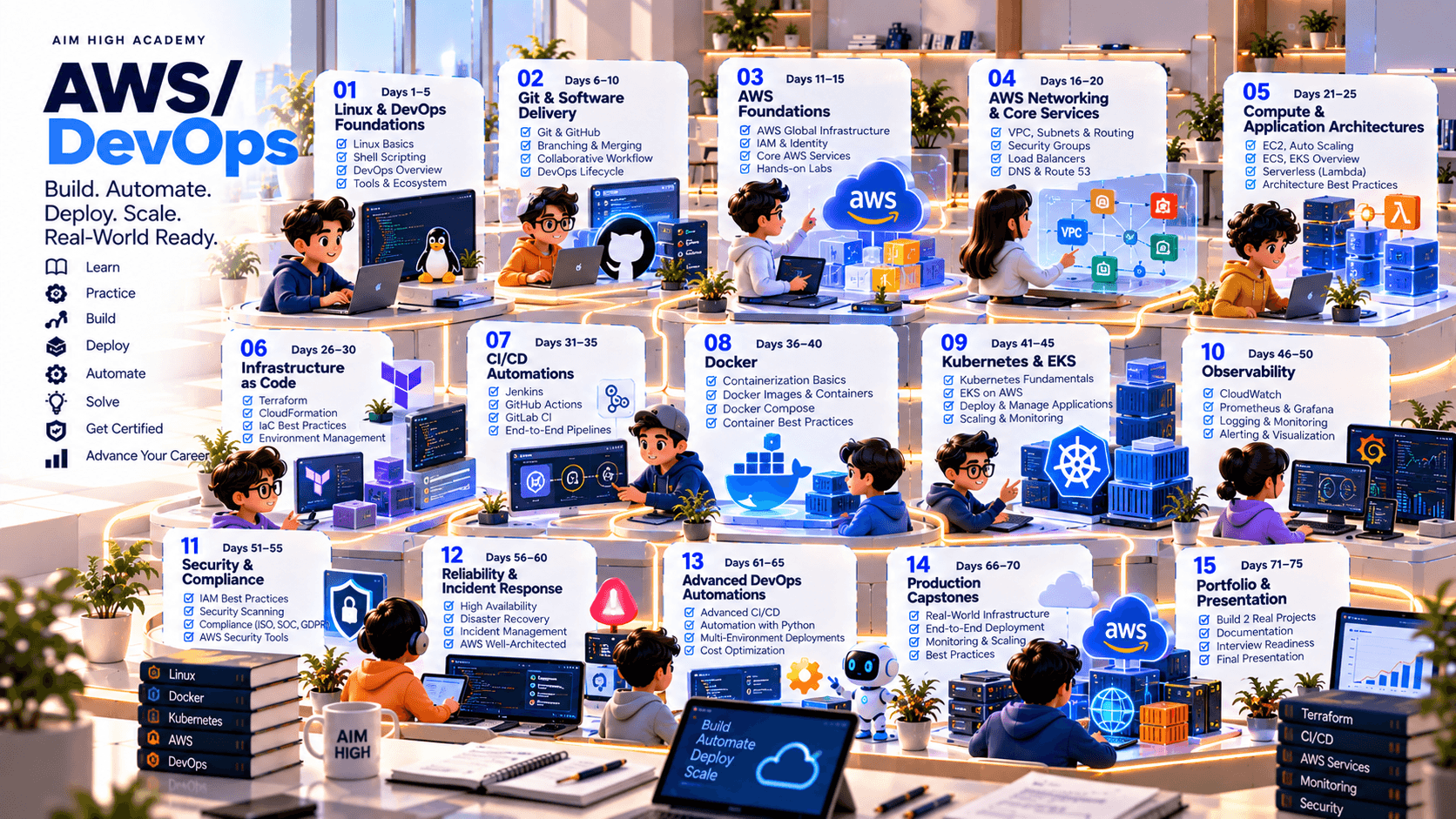
03 //Curriculum
Course phases.
04 //Technology stack
The tools you'll work with.
OS / shell
Server administration and automation
Linux + Bash
Version control
Collaboration and delivery
Git + GitHub
Cloud
Compute, networking, storage and managed services
AWS
CLI
Command-line AWS management
AWS CLI
Compute
Application compute
EC2 + Auto Scaling
Networking
Cloud networking and traffic management
VPC + ALB + Route 53 concepts
Storage
Object storage
S3
Database
Managed relational database
RDS
Serverless
Event-driven/serverless concepts
AWS Lambda
IaC
Versioned infrastructure provisioning
Terraform
Containers
Application packaging
Docker
Orchestration
Container orchestration
Kubernetes + EKS concepts
CI/CD
Automated delivery
GitHub Actions + AWS-native pipeline concepts
Observability
Metrics, logs, alarms and auditing
CloudWatch + CloudTrail concepts
Security
Identity, access and encryption
IAM + KMS/secrets concepts
05 //Projects and practice
Learning by doing.
- 01
Linux Automation Toolkit
Bash, processes, permissions, logs
- 02
Team Delivery Repository
Branches, PRs, review and release workflow
- 03
Highly Available Web App
EC2, VPC, ALB, S3
- 04
Secure AWS Network
Subnets, routes, security groups, IAM
- 05
Terraform AWS Environment
Terraform, modules, state and AWS provisioning
- 06
Automated Application Pipeline
Build, test, artifact and deployment stages
- 07
Containerized Application
Dockerfile, image, registry and runtime
- 08
Cloud-Native Deployment
Pods, Deployment, Service, scaling
- 09
Production Monitoring Stack
CloudWatch metrics, logs, alarms and runbook
- 10
Automated AWS DevOps Platform
IaC + CI/CD + containers + security + observability
06 //Capstone
Capstone options.
- 01
Highly Available Web Application
Provision AWS networking and compute with Terraform, deploy a containerized application through CI/CD, and monitor it with cloud observability.
- 02
Containerized Microservice Platform
Build and deploy multiple services with Docker/Kubernetes concepts, service discovery, rolling updates and monitoring.
- 03
Automated Cloud Deployment Platform
Create reusable Terraform modules and a multi-stage CI/CD pipeline for repeatable AWS environment delivery.
- 04
Serverless Application Pipeline
Build a Lambda/API-oriented application with automated testing, deployment, logging and alarms.
- 05
DevSecOps Cloud Platform
Integrate IAM, secure configuration, image checks, infrastructure validation, CI/CD and monitoring into one delivery workflow.
07 //Assessment
How progress is checked.
- Daily Linux and AWS CLI labs.
- Weekly infrastructure challenges.
- Git workflow and pull-request assessment.
- AWS architecture exercises.
- Terraform provisioning assignments.
- CI/CD pipeline implementation checkpoints.
- Docker and Kubernetes deployment labs.
- Monitoring and troubleshooting exercises.
- Security and IAM review checkpoints.
- Final capstone architecture, deployment, failure simulation and presentation review.
08 //Learning journey
From foundation to capability.
How learning builds through a course. It describes the approach, not a promised outcome.
Foundation to capability
How learning builds
Stage 01
Foundation
The core concepts, vocabulary and tools the rest of the course builds on.
Stage 02
Practice
Guided exercises that turn concepts into working skills.
Stage 03
Application
Applying those skills to realistic problems and project work.
Stage 04
Capability
Using what you've learned with growing independence and judgement.
09 //Questions
Frequently asked questions.
Start learning
Ready to start learning?
Ask about training to talk through where this course fits your goals.