
01 //Training course
Azure Devops
- Track
- Enterprise Technologies
- Duration
- 60 Days
02 //Why this course
Why this course.
The recommended architecture combines Azure fundamentals with Azure DevOps Services, Git, Azure Repos, Azure Pipelines, Azure Boards, Azure Artifacts and Azure Test Plans, then connects these delivery practices to Azure infrastructure, Docker, Infrastructure as Code, monitoring and production operations. Terraform is proposed as the cross-platform IaC tool, with Bicep introduced as an Azure-native infrastructure option.
The course should be positioned around the complete delivery lifecycle: plan → code → build → test → package → release → deploy → observe → secure → improve. Learners should repeatedly automate the process rather than simply learn individual Azure services.
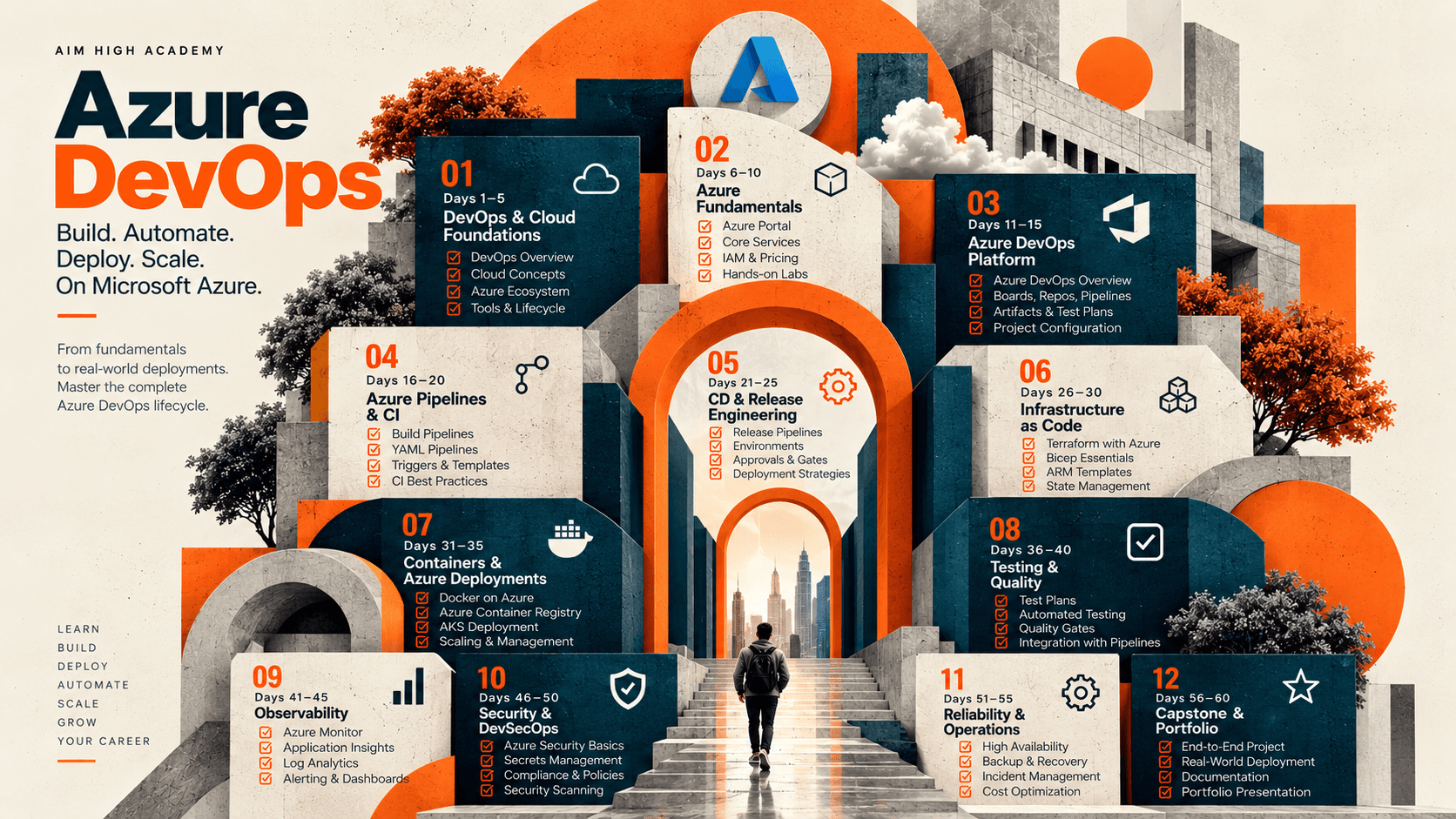
03 //Curriculum
Course phases.
04 //Technology stack
The tools you'll work with.
Cloud
Cloud infrastructure and application hosting
Microsoft Azure
DevOps platform
Planning, repos, pipelines, tests and artifacts
Azure DevOps
Source control
Collaboration and version control
Git + Azure Repos/GitHub
Planning
Work tracking and Agile delivery
Azure Boards
CI/CD
Automated build, test and deployment
Azure Pipelines
Artifacts
Package/artifact management
Azure Artifacts
Testing
Quality validation
Azure Test Plans + automated tests
IaC
Infrastructure automation
Terraform + Bicep concepts
Containers
Application packaging
Docker + Azure Container Registry
Orchestration
Kubernetes-based deployment
AKS concepts
Observability
Metrics, logs, traces and alerts
Azure Monitor + Application Insights
Identity
Authentication and authorization
Microsoft Entra ID + RBAC
Secrets
Secure secret management
Azure Key Vault
05 //Projects and practice
Learning by doing.
- 01
Git-Based Team Project
Git, branches, PRs, work tracking
- 02
Cloud Web Application
Resource groups, identity, compute, storage
- 03
Agile Delivery Board
Azure Boards, sprints, work items
- 04
Automated Build Pipeline
YAML, agents, tests, artifacts
- 05
Multi-Stage Deployment
Environments, approvals, rollback
- 06
Terraform Azure Environment
Terraform, state, modules, Azure
- 07
Containerized Azure App
Docker, registry, deployment
- 08
Automated Quality Gate
Tests, reports and pipeline checks
- 09
Production Monitoring Stack
Azure Monitor, Application Insights, alerts
- 10
Azure DevOps Delivery Platform
IaC + CI/CD + security + testing + monitoring
06 //Capstone
Capstone options.
- 01
Automated Web Application Delivery Platform
Provision Azure infrastructure with Terraform, build and test automatically, deploy through multi-stage pipelines, and monitor production health.
- 02
Containerized Azure Application
Build a containerized application, push images to a registry, deploy to an Azure container platform and automate releases.
- 03
DevSecOps Pipeline
Create a CI/CD workflow with identity, secrets, automated tests, security checks, approvals and deployment controls.
- 04
Enterprise Application Release Platform
Use Azure Boards, Repos, Pipelines, Artifacts, testing and monitoring to model a complete enterprise delivery workflow.
- 05
Infrastructure Automation Platform
Build reusable Terraform/Bicep modules and an automated pipeline for repeatable Azure environment provisioning.
07 //Assessment
How progress is checked.
- Daily Git/Azure CLI and cloud labs.
- Weekly Azure infrastructure challenges.
- Azure Boards planning exercises.
- Git branching and pull-request assessment.
- YAML CI/CD pipeline assignments.
- Terraform/Bicep provisioning checkpoints.
- Docker/container deployment labs.
- Testing and quality-gate assessments.
- Monitoring and incident-response exercises.
- Security/RBAC review checkpoints.
- Final capstone architecture, pipeline, deployment, monitoring and presentation review.
08 //Learning journey
From foundation to capability.
How learning builds through a course. It describes the approach, not a promised outcome.
Foundation to capability
How learning builds
Stage 01
Foundation
The core concepts, vocabulary and tools the rest of the course builds on.
Stage 02
Practice
Guided exercises that turn concepts into working skills.
Stage 03
Application
Applying those skills to realistic problems and project work.
Stage 04
Capability
Using what you've learned with growing independence and judgement.
09 //Questions
Frequently asked questions.
Start learning
Ready to start learning?
Ask about training to talk through where this course fits your goals.