02 //Why this course
Why this course.
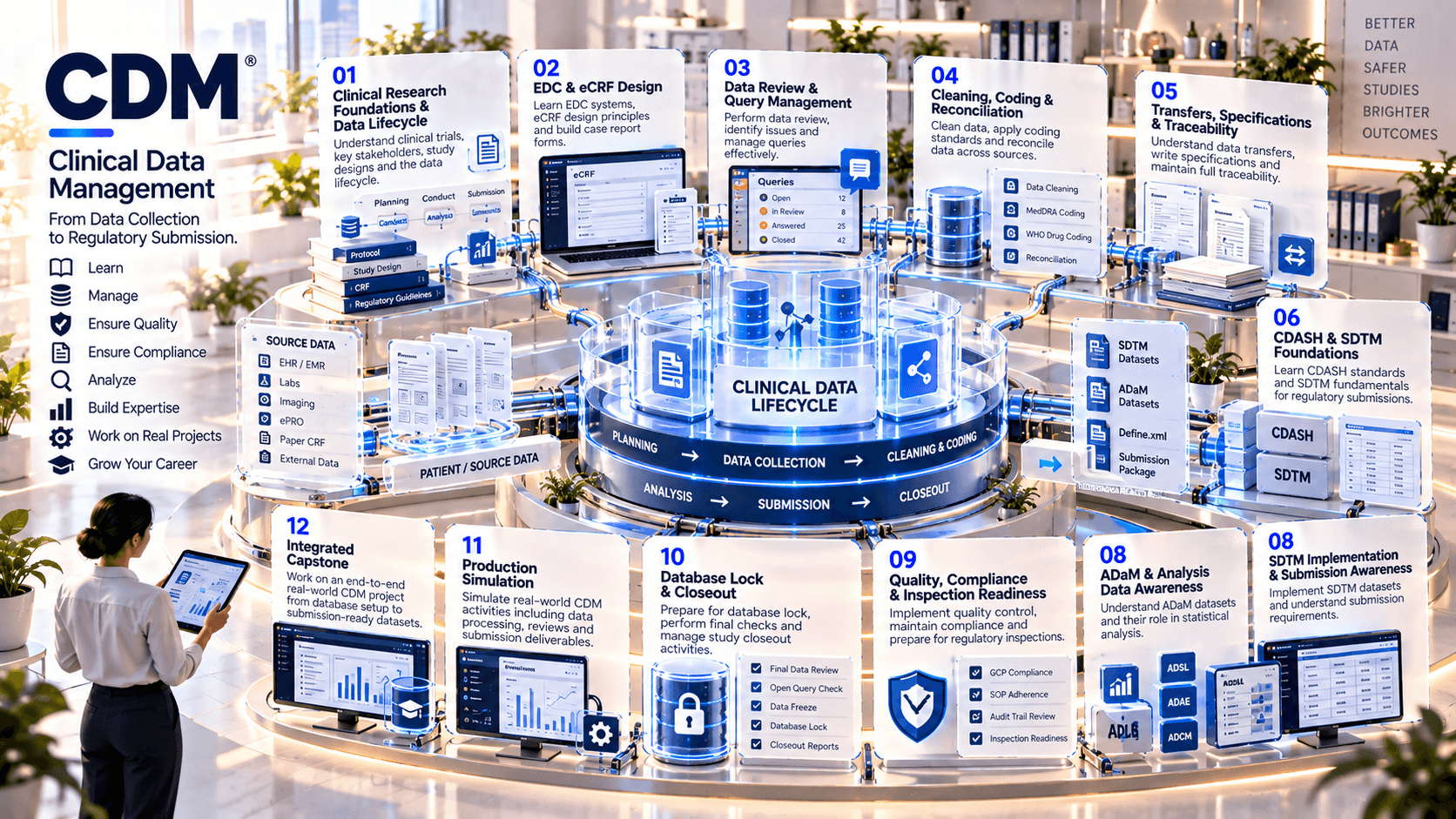
This 60-day Clinical Data Management (CDM) program is designed around the end-to-end flow of clinical-trial data: protocol and CRF design → electronic data capture (EDC) → data review and cleaning → medical coding and reconciliation → database lock readiness → standardized downstream data structures and regulatory traceability. It is intentionally operational rather than purely theoretical.
Clinical Data Management — EDC, Data Cleaning, CDISC Standards & Clinical Trial Data Operations
Move from raw clinical observations to clean, reviewable, traceable clinical data.
03 //Curriculum
Course phases.
04 //Technology stack
The tools you'll work with.
EDC / clinical database
Hands-on study build and data review
Training sandbox or simulated EDC; licensed commercial EDC only where permitted
Data standards
Standardized collection, tabulation, analysis and metadata
CDASH, SDTM, ADaM, Define-XML, CDISC Controlled Terminology
Coding dictionaries
Medical terminology coding workflows
MedDRA / WHO Drug or licensed equivalent
Data work
Cleaning, reconciliation and data checks
Excel, SQL fundamentals, CSV/JSON, controlled templates
Validation
Quality control and standards review
Metadata/standards validation utilities and sponsor/CRO-style checklists
Documentation
DMPs, specifications, review evidence and presentations
Word/Excel/PowerPoint or equivalent; controlled repositories
Version control
Change history and reproducibility
Git/GitHub or controlled document repository
Privacy
Safe training environment
Synthetic/de-identified datasets only
05 //Projects and practice
Learning by doing.
- 01
Study Data Flow Map
Map protocol → CRF → EDC → review → cleaning → coding → reconciliation → lock → downstream standards.
- 02
eCRF & Edit-Check Specification
Design a synthetic study's forms, fields, controlled values and representative edit checks.
- 03
Query Management Lab
Generate discrepancies, write high-quality queries, prioritize them and track closure.
- 04
Coding & Reconciliation Lab
Process synthetic adverse-event/concomitant-medication examples and reconcile external data.
- 05
CDISC Mapping Lab
Annotate a sample CRF and map representative collected data to CDISC structures.
- 06
Database Lock Readiness
Produce a final cleaning tracker, reconciliation status, open-issue review and lock checklist.
06 //Capstone
Capstone options.
- 01
Phase II/III-style therapeutic study: full CDM lifecycle from CRF specification to lock readiness.
- 02
Device study variant: add device-specific data and traceability considerations.
- 03
Multi-vendor study: reconcile central lab, ePRO/eCOA and safety-related external data.
- 04
Inspection-readiness variant: emphasize audit trails, quality evidence, controlled documents and issue management.
07 //Assessment
How progress is checked.
- Knowledge checks
- Hands-on labs
- Standards exercises
- Quality & lock simulation
- Capstone
- Professional presentation
08 //Learning journey
From foundation to capability.
How learning builds through a course. It describes the approach, not a promised outcome.
Foundation to capability
How learning builds
Stage 01
Foundation
The core concepts, vocabulary and tools the rest of the course builds on.
Stage 02
Practice
Guided exercises that turn concepts into working skills.
Stage 03
Application
Applying those skills to realistic problems and project work.
Stage 04
Capability
Using what you've learned with growing independence and judgement.
09 //Questions
Frequently asked questions.
Start learning
Ready to start learning?
Ask about training to talk through where this course fits your goals.