
01 //Training course
Cyber Security
- Track
- Enterprise Technologies
- Duration
- 60 Days
02 //Why this course
Why this course.
Cyber Security is proposed as a 60-day, practical security-engineering program that develops foundational knowledge of networks, operating systems, security principles, identity, vulnerabilities, application security, defensive monitoring, incident response, cloud security and ethical security testing.
The recommended structure moves from fundamentals to controlled hands-on security work: understand systems and attack surfaces → identify vulnerabilities → apply defensive controls → investigate events → test applications and networks in authorized environments → harden systems → document and communicate findings.
The course should emphasize legal, authorized and isolated lab environments. Offensive-security exercises should be framed around owned or explicitly authorized systems, with safe lab targets and clear rules of engagement.
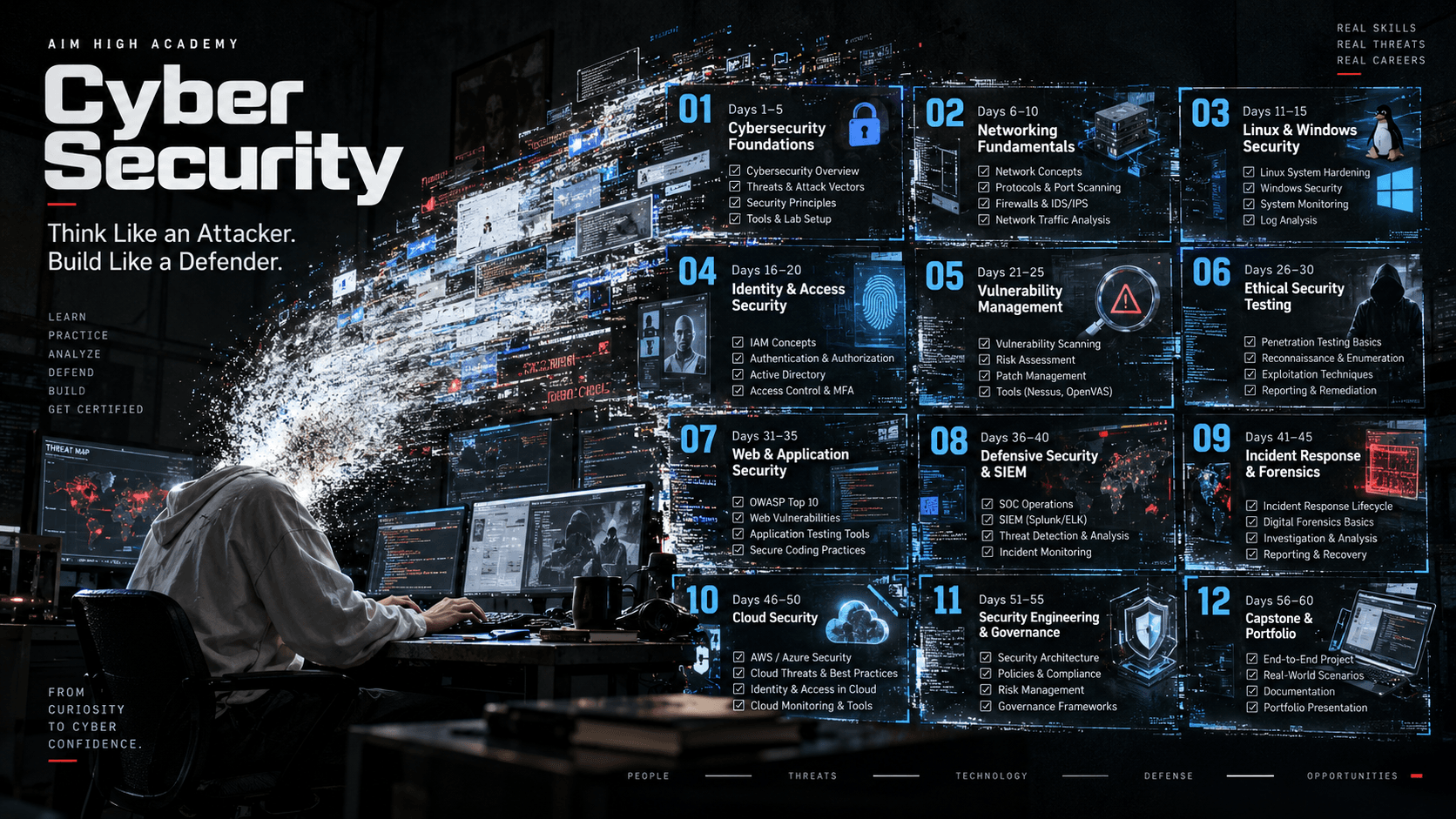
03 //Curriculum
Course phases.
04 //Technology stack
The tools you'll work with.
Operating systems
System administration and security fundamentals
Linux + Windows
Networking
Network security foundation
TCP/IP, DNS, HTTP/S, firewalls
Virtualization
Safe security experimentation
Virtual machines / isolated lab network
Security testing
Authorized assessment
Nmap concepts, Burp Suite concepts, controlled vulnerability tools
Web security
Application-security practice
OWASP-oriented training applications
Scripting
Automation and security tooling
Python + Bash / PowerShell basics
Monitoring
Detection and investigation
SIEM concepts + centralized logs
Endpoint
Defensive security
Host hardening and endpoint telemetry concepts
Cloud
Cloud security practice
AWS/Azure security fundamentals
Version control
Security scripts and portfolio documentation
Git/GitHub
Documentation
Professional delivery
Security reports, diagrams and remediation plans
05 //Projects and practice
Learning by doing.
- 01
Secure Lab Build
Virtualization, networking, accounts and baseline hardening
- 02
Network Visibility Lab
Traffic analysis, services, ports and segmentation
- 03
Linux/Windows Hardening
Permissions, services, logs and configuration
- 04
Access-Control Design
Authentication, authorization, MFA and least privilege
- 05
Vulnerability Assessment
Asset discovery, scanning, risk classification and remediation
- 06
Authorized Web Security Review
HTTP, authentication, input validation and OWASP-oriented risks
- 07
SIEM/Log Investigation
Log sources, detection logic, alert triage and investigation
- 08
Incident Response Simulation
Triage, containment, evidence concepts and reporting
- 09
Cloud Security Review
IAM, network controls, storage, secrets and monitoring
- 10
End-to-End Security Assessment
Assessment + hardening + detection + reporting
06 //Capstone
Capstone options.
- 01
Enterprise Security Assessment
Assess an authorized lab enterprise environment, identify risks, prioritize findings and propose remediation.
- 02
Web Application Security Review
Review an intentionally vulnerable training application, document findings and demonstrate secure remediation.
- 03
SOC Investigation Simulation
Analyze simulated security events, identify suspicious activity, triage alerts and produce an incident report.
- 04
Cloud Security Architecture
Design a secure cloud environment covering identity, network segmentation, secrets, logging and monitoring.
- 05
Blue-Team Hardening Project
Start from a deliberately weak lab environment, harden systems, improve monitoring and validate controls.
07 //Assessment
How progress is checked.
- Daily command-line, networking and security exercises.
- Weekly lab submissions.
- Network traffic analysis checkpoints.
- Linux/Windows hardening assessments.
- Vulnerability identification and risk-prioritization tasks.
- Authorized web-security assessment tasks.
- SIEM/log investigation exercises.
- Incident-response tabletop simulation.
- Cloud security architecture review.
- Security report writing and executive-summary assessment.
- Final capstone demonstration and technical review.
08 //Learning journey
From foundation to capability.
How learning builds through a course. It describes the approach, not a promised outcome.
Foundation to capability
How learning builds
Stage 01
Foundation
The core concepts, vocabulary and tools the rest of the course builds on.
Stage 02
Practice
Guided exercises that turn concepts into working skills.
Stage 03
Application
Applying those skills to realistic problems and project work.
Stage 04
Capability
Using what you've learned with growing independence and judgement.
09 //Questions
Frequently asked questions.
Start learning
Ready to start learning?
Ask about training to talk through where this course fits your goals.