01 //Training course
Data Engineeering
- Track
- Data & Analytics
- Duration
- 60 Days
02 //Why this course
Why this course.
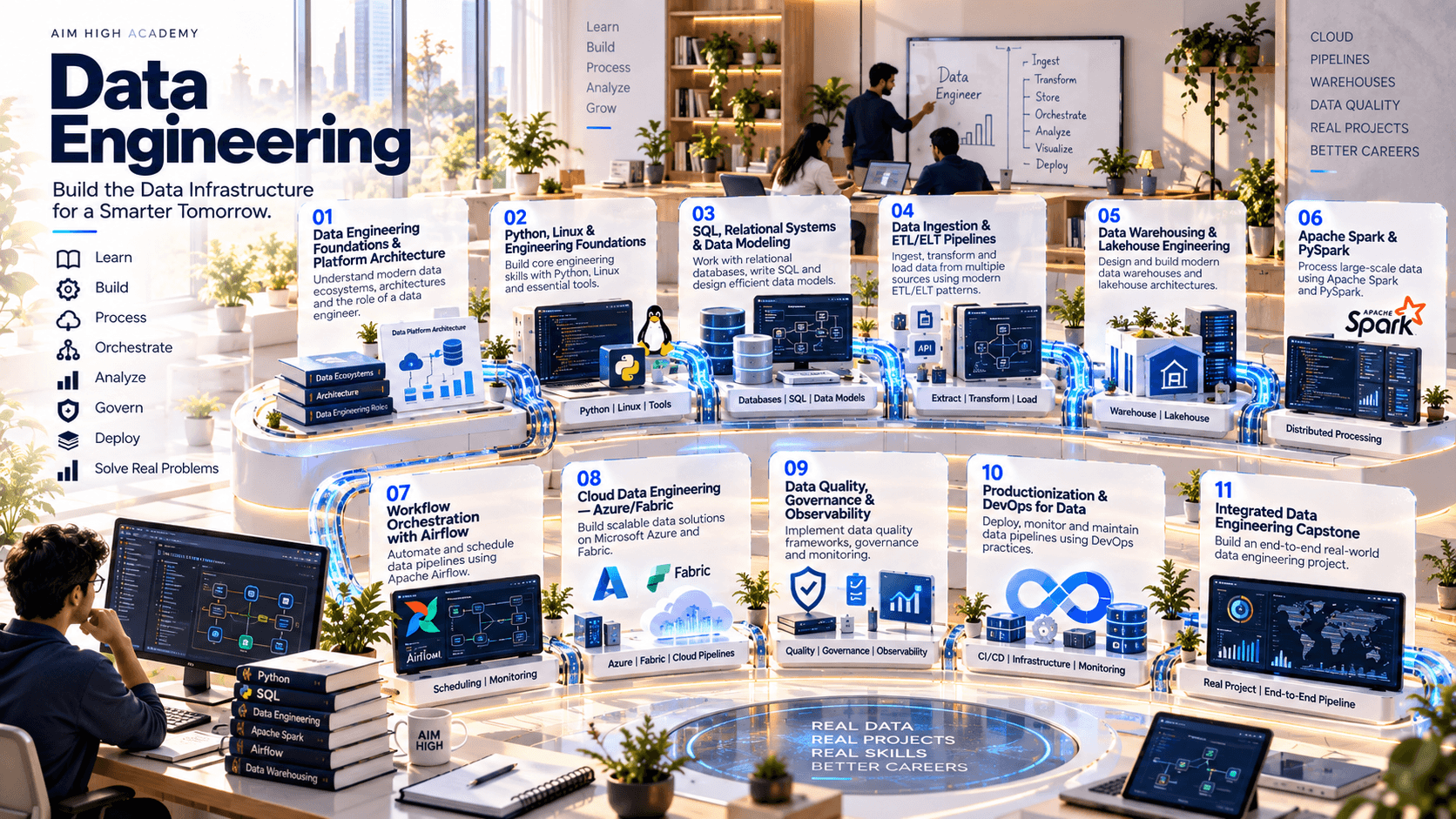
This 60-day Data Engineering program is designed around the modern data platform lifecycle: ingest data from multiple sources → validate and transform it → store it in reliable lake/warehouse structures → orchestrate repeatable pipelines → process larger datasets → apply quality, lineage and governance controls → publish production-ready data assets for analytics and downstream applications.
Data Engineering — Python, SQL, ETL/ELT, Data Warehousing, Spark, Airflow & Cloud Data Platforms
Build reliable pipelines instead of isolated scripts.
03 //Curriculum
Course phases.
04 //Technology stack
The tools you'll work with.
Databases
Relational storage, SQL and source-system simulation
PostgreSQL; optional SQL Server/MySQL
Data formats
File-based ingestion and efficient analytical storage
CSV, JSON, Parquet, Avro awareness
Transformation
ETL/ELT and scalable processing
SQL, pandas for small data, PySpark for distributed workloads
Distributed compute
Large-scale transformation and analytical processing
Apache Spark / PySpark
Cloud
Cloud ingestion, storage and analytics architecture
Azure Data Lake Storage, Azure Data Factory; Microsoft Fabric
Lakehouse
Layered analytical storage and scalable processing
Microsoft Fabric Lakehouse / Delta concepts
Version control
Code versioning, collaboration and CI/CD
Git, GitHub
Observability
Pipeline health and incident diagnosis
Airflow UI, logs, metrics, cloud monitoring
Optional DevOps
Repeatable deployment and environment management
GitHub Actions, Docker, Terraform/Bicep concepts
05 //Projects and practice
Learning by doing.
- 01
Source-to-Lake Ingestion
Ingest files and API data into a raw storage layer with schema validation and audit metadata.
- 02
Warehouse Modeling
Convert normalized source data into a star-schema analytical model with fact and dimension tables.
- 03
Incremental ETL/ELT Pipeline
Implement watermark-based incremental processing, idempotency and failure recovery.
- 04
PySpark Transformation Pipeline
Process a larger synthetic dataset with joins, aggregations, partitioning and performance checks.
- 05
Airflow Production Workflow
Orchestrate ingestion and transformation tasks with retries, parameters, dependencies and operational monitoring.
- 06
Cloud Data Platform
Build a cloud-oriented pipeline using Azure/Fabric services and document security, storage and monitoring decisions.
06 //Capstone
Capstone options.
- 01
Retail Data Platform
orders, customers, products, inventory and daily analytics.
- 02
FinTech Analytics Platform
transactions, accounts, risk indicators and compliance-ready data flows.
- 03
Healthcare Analytics Platform
synthetic/de-identified patient encounters, claims and operational metrics.
- 04
Marketing Data Platform
campaign, web-event, CRM and conversion datasets.
- 05
Logistics Data Platform
shipments, routes, warehouses, delivery events and SLA analytics.
07 //Assessment
How progress is checked.
- Engineering foundations
- SQL & data modeling
- Pipeline engineering labs
- Spark / PySpark
- Airflow orchestration
- Cloud data engineering
- Integrated capstone
08 //Learning journey
From foundation to capability.
How learning builds through a course. It describes the approach, not a promised outcome.
Foundation to capability
How learning builds
Stage 01
Foundation
The core concepts, vocabulary and tools the rest of the course builds on.
Stage 02
Practice
Guided exercises that turn concepts into working skills.
Stage 03
Application
Applying those skills to realistic problems and project work.
Stage 04
Capability
Using what you've learned with growing independence and judgement.
09 //Questions
Frequently asked questions.
Start learning
Ready to start learning?
Ask about training to talk through where this course fits your goals.