
01 //Training course
Data Science (AI/ML)
- Track
- Data & Analytics
- Duration
- 75 Days
02 //Why this course
Why this course.
Data Science (AI/ML) is proposed as a 75-day, project-led program that develops the learner's ability to work with data from collection and cleaning through exploratory analysis, statistical reasoning, machine learning, model evaluation and practical AI workflows.
The recommended stack centers on Python, NumPy, pandas, SQL, visualization, statistics, scikit-learn and a selected deep-learning framework such as PyTorch. The program should also introduce responsible AI, model interpretability, reproducibility and deployment concepts so learners understand the lifecycle beyond simply training a model.
The course should be positioned as a connected data-to-model journey: collect → clean → explore → understand → model → evaluate → explain → deploy → communicate. Every phase should produce a practical artifact that contributes toward a final capstone.
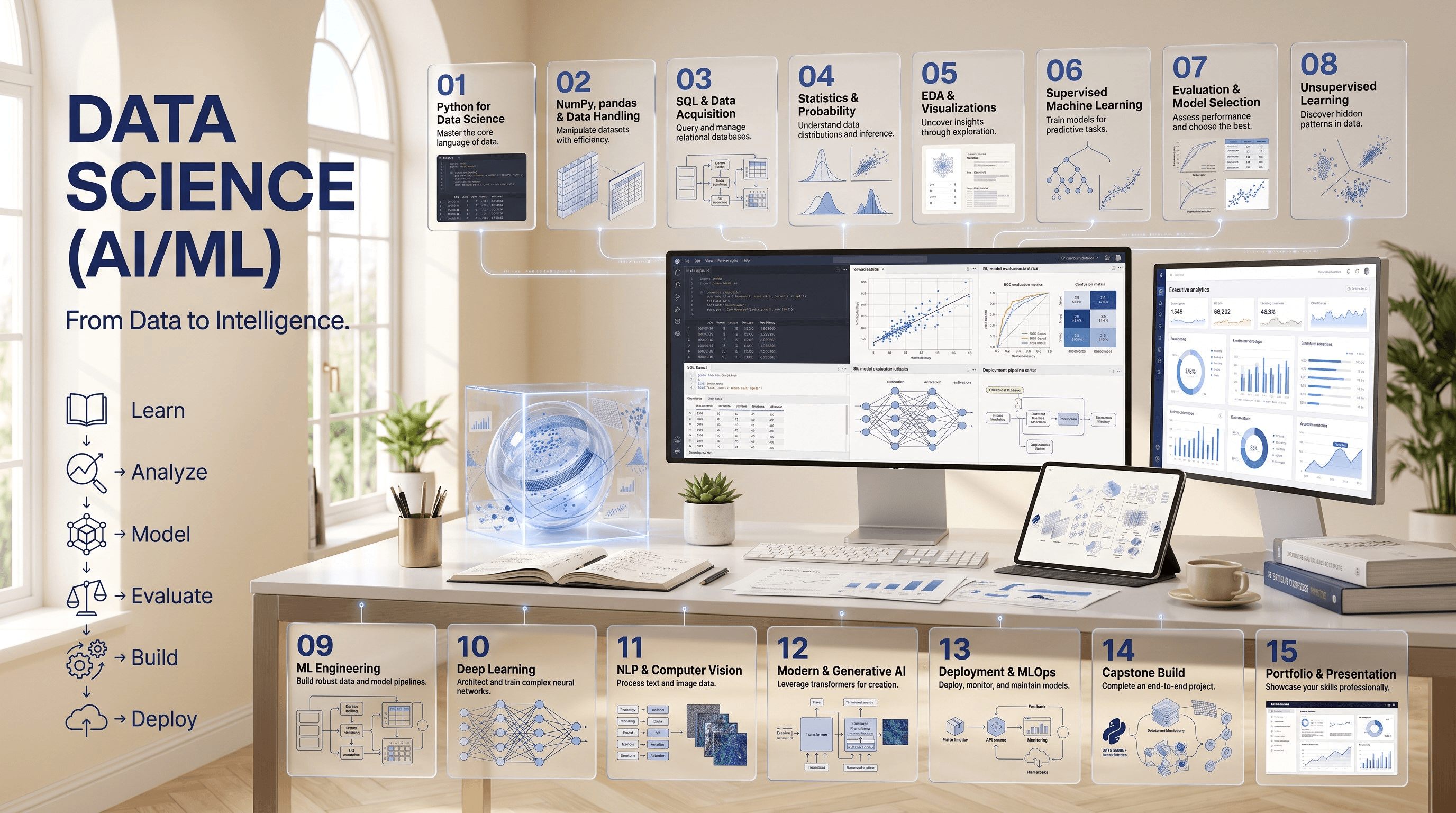
03 //Curriculum
Course phases.
04 //Technology stack
The tools you'll work with.
Language
Programming and ML workflows
Python
Data arrays
Numerical computing
NumPy
Data analysis
Data manipulation and preparation
pandas
Database
Structured data querying
SQL + PostgreSQL/MySQL
Visualization
Exploration and communication
Matplotlib + Seaborn or approved equivalent
Classical ML
Modeling, preprocessing and evaluation
scikit-learn
Deep learning
Neural-network development
PyTorch or approved equivalent
Notebook workflow
Exploration and experimentation
Jupyter
Version control
Reproducibility and portfolio
Git + GitHub
Deployment
Model inference API
FastAPI/Flask or approved serving layer
Containers
Portable deployment
Docker
Experiment/MLOps
Experiment/model tracking concepts
MLflow or approved equivalent
05 //Projects and practice
Learning by doing.
- 01
Data Cleaning Toolkit
Python, files, functions, reusable code
- 02
Sales/Customer Analysis
pandas, NumPy, cleaning, transformation
- 03
Business Intelligence Dataset
SQL queries, joins, aggregation
- 04
A/B or Customer Behavior Analysis
Probability, sampling, hypothesis concepts
- 05
Executive Analytics Report
Visualization, storytelling, insights
- 06
Churn/Price/Risk Prediction
Feature engineering, supervised learning
- 07
Customer Segmentation
Clustering, dimensionality reduction
- 08
Image/Text Classifier
Neural networks, training and evaluation
- 09
Applied AI Prototype
Embeddings/LLM or applied AI workflow
- 10
Model Inference API
Serving, Docker, API integration
- 11
End-to-End Data Science/AI System
Data → model → evaluation → application → presentation
06 //Capstone
Capstone options.
- 01
Customer Churn Prediction System
Data pipeline, EDA, feature engineering, classification model, evaluation dashboard and prediction API.
- 02
Demand Forecasting Platform
Historical data preparation, time-series concepts, forecasting model, evaluation and visualization.
- 03
Fraud/Risk Detection System
Imbalanced classification, feature engineering, precision/recall analysis and inference API.
- 04
Recommendation Prototype
User/item data, similarity or ranking approach, evaluation and application interface.
- 05
AI Document Intelligence Prototype
Document ingestion, text extraction, embeddings/LLM workflow, evaluation and user-facing interface.
07 //Assessment
How progress is checked.
- Daily Python/data exercises.
- Weekly dataset and analysis assignments.
- SQL and statistics checkpoints.
- EDA report assessment.
- Machine-learning model-building assignments.
- Model evaluation and error-analysis reviews.
- Deep-learning mini-project.
- Applied AI prototype assessment.
- Deployment/MLOps checkpoint.
- Final capstone architecture, model, evaluation, documentation and presentation review.
08 //Learning journey
From foundation to capability.
How learning builds through a course. It describes the approach, not a promised outcome.
Foundation to capability
How learning builds
Stage 01
Foundation
The core concepts, vocabulary and tools the rest of the course builds on.
Stage 02
Practice
Guided exercises that turn concepts into working skills.
Stage 03
Application
Applying those skills to realistic problems and project work.
Stage 04
Capability
Using what you've learned with growing independence and judgement.
09 //Questions
Frequently asked questions.
Start learning
Ready to start learning?
Ask about training to talk through where this course fits your goals.