01 //Training course
Generative AI
Recommended positioning: build real-world AI applications with LLMs, RAG, multimodal models, agents and production APIs.
- Track
- AI & Emerging Technologies
- Duration
- 75 Days
02 //Why this course
Why this course.
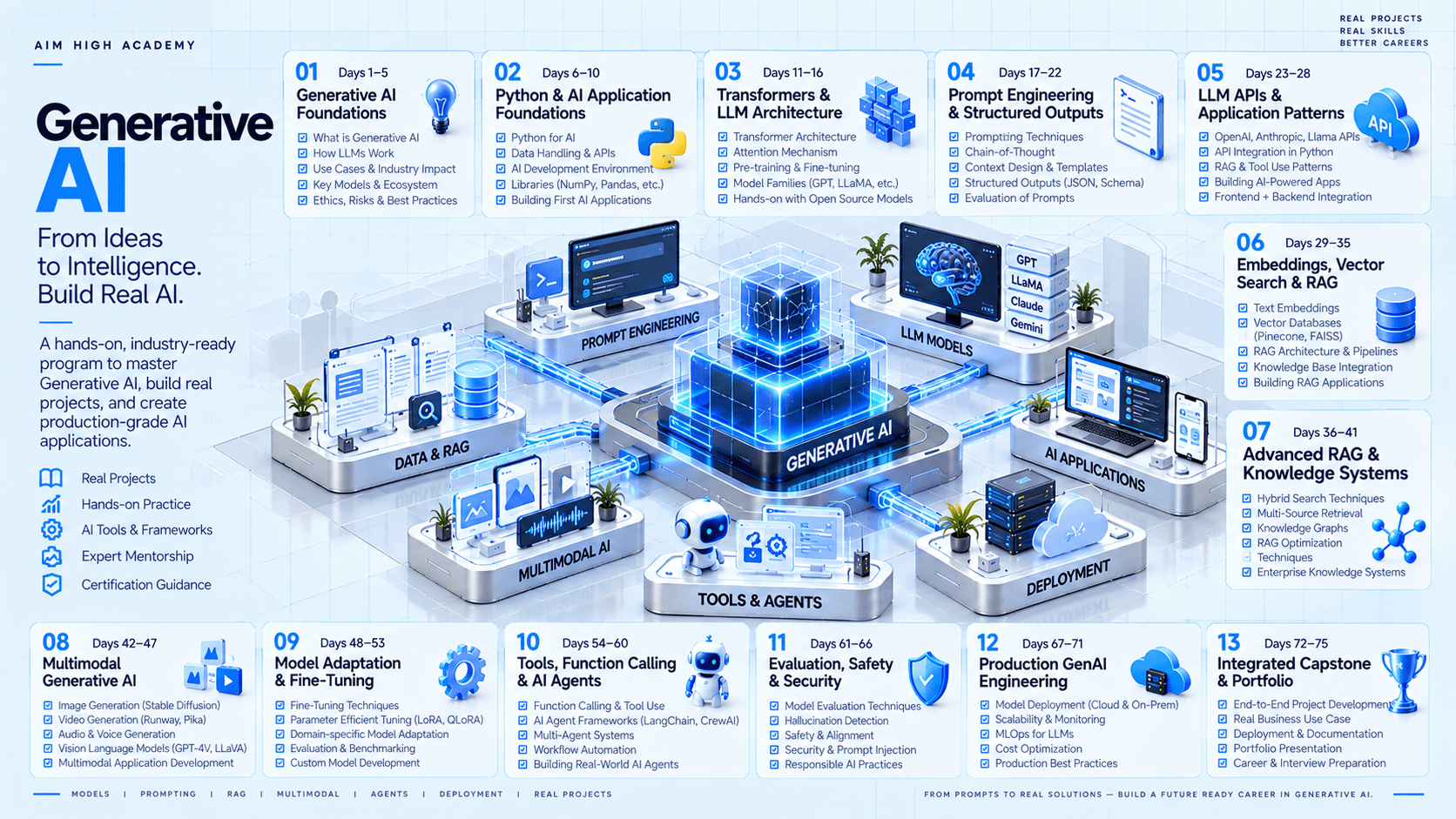
Generative AI is best taught as an application-engineering discipline rather than as prompt writing alone. The architecture moves from the foundations of generative models and transformers into prompt engineering, structured outputs, embeddings, retrieval-augmented generation, multimodal systems, model adaptation, tool calling, agents, evaluation, safety and production deployment.
The program is designed to produce portfolio-grade systems: learners repeatedly move through the loop of problem definition, model selection, prompting and context, implementation, evaluation, security and deployment.
03 //Learning outcomes
What you'll be able to do.
- 01
Model literacy
Explain tokens, context, attention, transformers, decoding and model families at an application-engineering level.
- 02
Prompt engineering
Design reliable prompts using roles, constraints, examples, structured output and iterative evaluation.
- 03
LLM application development
Build applications around hosted model APIs and open-source models.
- 04
RAG
Create document ingestion, chunking, embeddings, retrieval, reranking/context assembly and grounded generation pipelines.
- 05
Multimodal AI
Work with text plus image, audio, video or document inputs where supported by the selected model/API.
- 06
Fine-tuning
Prepare datasets and understand supervised fine-tuning, preference optimization and parameter-efficient adaptation.
- 07
Agents
Build tool-using workflows with function calling, state, planning/orchestration and guardrails.
- 08
Evaluation
Create datasets, rubrics, automated checks and regression evaluations for GenAI behavior.
- 09
Production
Deploy APIs/apps, manage secrets, monitor quality/cost/latency and design safe failure paths.
04 //Curriculum
Course phases.
05 //Technology stack
The tools you'll work with.
Language
Primary application and AI engineering language.
Python 3.x
Development
Development, notebooks, version control.
VS Code / Jupyter / Git / GitHub
Model APIs
Hosted generative-model integration and comparison.
OpenAI API; Google Gemini API; other approved provider APIs
Open source
Pretrained models, inference and adaptation experiments.
Hugging Face Transformers + Hub
Deep learning
Model experimentation and transformer foundations.
PyTorch
Embeddings
Semantic representation for retrieval.
Provider embeddings + open-source embedding models
Vector search
Similarity search and RAG storage.
FAISS / Qdrant / pgvector or approved equivalent
RAG framework
Retrieval/tool orchestration where useful; teach underlying primitives first.
LangChain or lightweight custom Python pipelines
API
Production-style AI services.
FastAPI
Database
Application data, metadata and optional pgvector.
PostgreSQL
Deployment
Containerized deployment and reproducibility.
Docker + cloud platform
Evaluation
Quality and regression testing.
Custom eval harness + provider evaluation tools / approved framework
Observability
Production debugging and monitoring.
Structured logging + traces + metrics
06 //Projects and practice
Learning by doing.
- 01
AI Content & Structured Output Studio
Prompt design, schemas, validation and reusable workflows.
- 02
Enterprise Document Q&A
Document ingestion, chunking, embeddings, retrieval and grounded answers.
- 03
Knowledge Intelligence Assistant
Advanced RAG, query rewriting, reranking and source citations.
- 04
Multimodal Document Analyst
PDF/image understanding and structured information extraction.
- 05
Domain Adaptation Experiment
Dataset preparation, fine-tuning/PEFT experiment and evaluation.
- 06
Tool-Using AI Agent
Function calling, APIs, state, approvals and agent evaluation.
- 07
GenAI Safety & Evaluation Lab
Adversarial prompts, injection tests, groundedness and regression evaluation.
- 08
Production GenAI Service
FastAPI + Docker + monitoring + deployment.
- 09
Final Capstone
Integrated enterprise-grade GenAI product.
07 //Capstone
Capstone options.
- 01
Enterprise Knowledge Copilot
Internal documents + RAG + citations + access controls.
- 02
AI Research Assistant
Web/data tools + retrieval + source tracking + report generation.
- 03
Customer Support Agent
Knowledge base + tool calls + escalation + evaluation.
- 04
Document Intelligence Platform
Multimodal extraction + validation + workflow automation.
- 05
AI Sales Intelligence System
CRM context + retrieval + structured outputs + analytics.
- 06
Developer Copilot
Code/document context + tool use + test generation + review workflow.
- 07
Marketing Intelligence Agent
Research, content planning, structured outputs and approval workflow.
08 //Learning methodology
How the course is taught.
- Hands-on, project-based and lab-driven.
- Each phase follows the same rhythm: concept, instructor-led live build, individual or paired lab, evaluation, and portfolio work.
09 //Assessment
How progress is checked.
- Weekly labs — hands-on implementation and Git commits/notebooks.
- Mini-projects — functional AI applications with README and demo.
- RAG, multimodal and adaptation projects — architecture, implementation and evaluation evidence.
- Agent and tool integration project — tool schemas, execution traces and safety controls.
- Evaluation and security lab — test dataset, failure analysis and regression checks.
- Production deployment project — API, container, deployment and observability.
- Final capstone — working product, architecture, evaluation, documentation and presentation.
10 //Learning journey
From foundation to capability.
How learning builds through a course. It describes the approach, not a promised outcome.
Foundation to capability
How learning builds
Stage 01
Foundation
The core concepts, vocabulary and tools the rest of the course builds on.
Stage 02
Practice
Guided exercises that turn concepts into working skills.
Stage 03
Application
Applying those skills to realistic problems and project work.
Stage 04
Capability
Using what you've learned with growing independence and judgement.
11 //Career preparation
Preparing to present the work.
- 01
GitHub portfolio
- 02
Documentation and README
- 03
Demo
- 04
Portfolio presentation
12 //Questions
Frequently asked questions.
Start learning
Ready to start learning?
Ask about training to talk through where this course fits your goals.