
01 //Training course
Medical Coding
- Track
- Professional & Career Skills
- Duration
- 60 Days
02 //Why this course
Why this course.
This 60-day program is designed as a practical medical coding pathway centered on U.S. diagnosis and procedure coding. It builds from medical terminology, anatomy and healthcare documentation into ICD-10-CM diagnosis coding, CPT procedure coding, HCPCS Level II, modifiers, coding guidelines, documentation review, claims-oriented workflows, compliance, auditing and integrated case-based coding.
CMS describes ICD-10-CM as the U.S. clinical modification used to classify diagnoses and reasons for visits across healthcare settings, with official coding guidelines developed by CMS, NCHS, AHA and AHIMA. CMS also distinguishes ICD-10-PCS for inpatient procedures.
AMA maintains the CPT code set for reporting medical services and procedures performed by physicians and other qualified healthcare professionals. CMS describes HCPCS as having Level I (CPT) and Level II, with Level II primarily covering products, supplies and services not included in CPT.
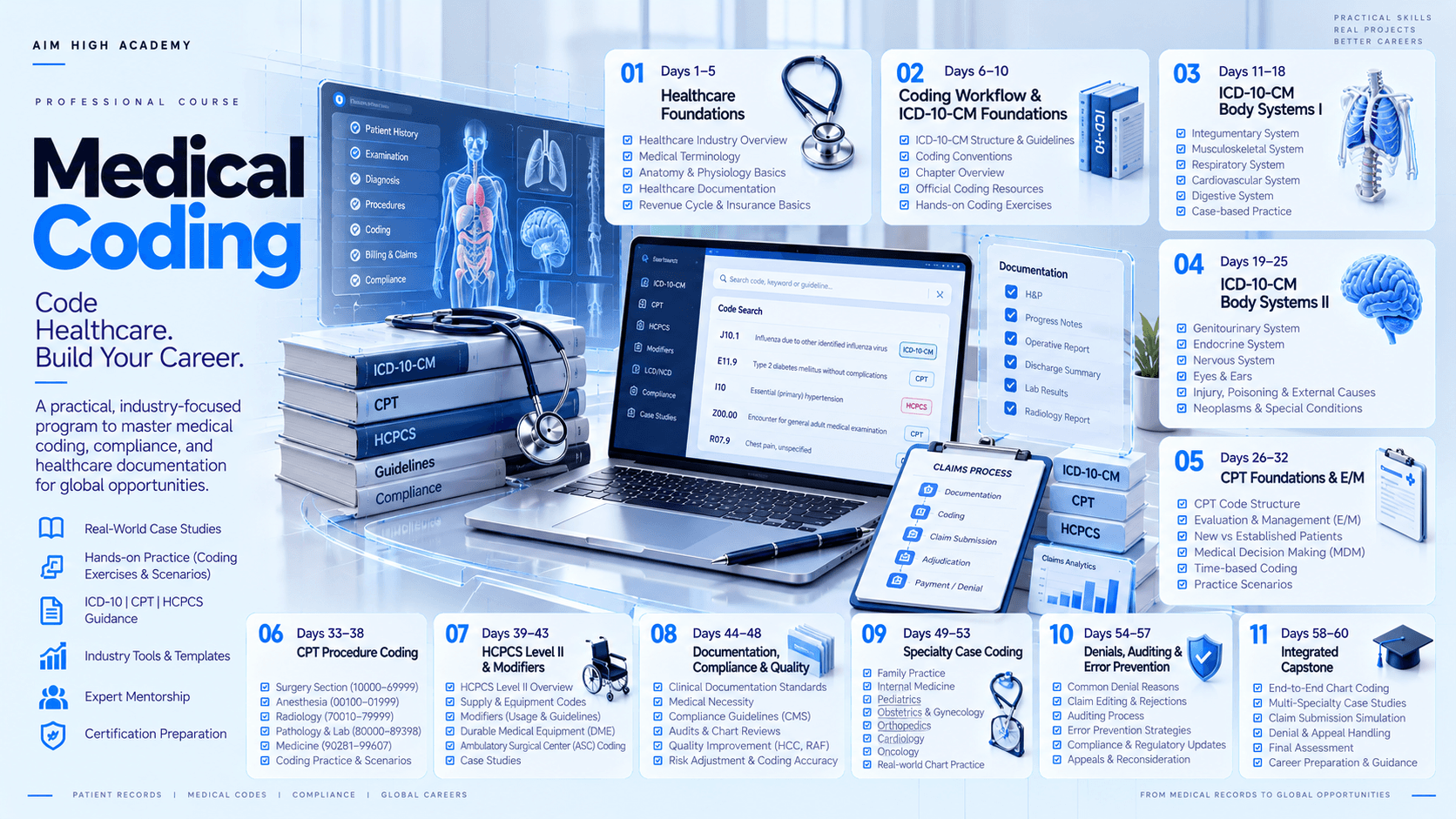
03 //Curriculum
Course phases.
04 //Technology stack
The tools you'll work with.
Tools
Current-year ICD-10-CM official files and guidelines from CMS
Current CPT Professional Edition / authorized CPT reference from AMA
Current HCPCS Level II files from CMS
Medical coding encoder / code lookup platform licensed for education
Electronic health record / simulated chart environment
Claim-form / claim-simulation environment
Spreadsheet tools for audit and coding-quality exercises
Secure learning management system
Synthetic or authorized de-identified medical records
Notes
The final course must specify the exact code year and authorized codebook/encoder access. CPT content is proprietary to AMA, and current code sets change annually; the curriculum should not reproduce protected codebook content wholesale.
05 //Projects and practice
Learning by doing.
- 01
Medical Record Interpretation Lab
Read synthetic clinical documentation, identify diagnoses/procedures, terminology and documentation gaps.
- 02
ICD-10-CM Coding Workbook
Assign diagnosis codes across body systems using the Alphabetic Index, Tabular List and official guidelines.
- 03
CPT Procedure Coding Lab
Translate procedure documentation into appropriate CPT selections while applying descriptors, guidelines and bundling concepts.
- 04
HCPCS & Modifier Lab
Select Level II codes and modifiers for controlled supply/service scenarios and explain the coding rationale.
- 05
Documentation Quality Review
Identify missing specificity, unsupported diagnoses, contradictory documentation and query opportunities.
- 06
Coding Audit Lab
Review a coded chart set, identify errors, classify root causes and calculate an accuracy-focused audit summary.
- 07
Denial Prevention Simulation
Analyze fictional claim denials and trace them to coding, documentation, modifier, sequencing or data-quality issues.
- 08
Integrated Medical Coding Capstone
Code a complete synthetic case portfolio across diagnosis, procedures and supplies, then conduct an independent audit.
06 //Capstone
Capstone options.
- 01
Multi-Specialty Outpatient Coding Portfolio
physician/clinic cases across several body systems.
- 02
Hospital Coding Simulation
diagnosis/procedure documentation with sequencing and inpatient/outpatient distinctions clearly scoped.
- 03
Revenue Cycle Coding Quality Project
code accuracy, documentation mismatch, modifier errors and denial-prevention analysis.
- 04
Specialty Coding Portfolio
select one specialty and build a 20–30 case synthetic portfolio with rationale.
- 05
Coding Audit & Compliance Project
perform an audit on a controlled dataset and present findings, error patterns and corrective actions.
07 //Assessment
How progress is checked.
- Medical terminology & anatomy
- ICD-10-CM conventions & diagnosis coding
- CPT / E&M / procedure coding
- HCPCS & modifiers
- Documentation & compliance casework
- Specialty coding labs
- Audit / denial-prevention project
- Integrated capstone
- Coding rationale / portfolio presentation
08 //Learning journey
From foundation to capability.
How learning builds through a course. It describes the approach, not a promised outcome.
Foundation to capability
How learning builds
Stage 01
Foundation
The core concepts, vocabulary and tools the rest of the course builds on.
Stage 02
Practice
Guided exercises that turn concepts into working skills.
Stage 03
Application
Applying those skills to realistic problems and project work.
Stage 04
Capability
Using what you've learned with growing independence and judgement.
09 //Questions
Frequently asked questions.
Start learning
Ready to start learning?
Ask about training to talk through where this course fits your goals.