
01 //Training course
MERN Full Stack
- Track
- Programming
- Duration
- 60 Days
02 //Why this course
Why this course.
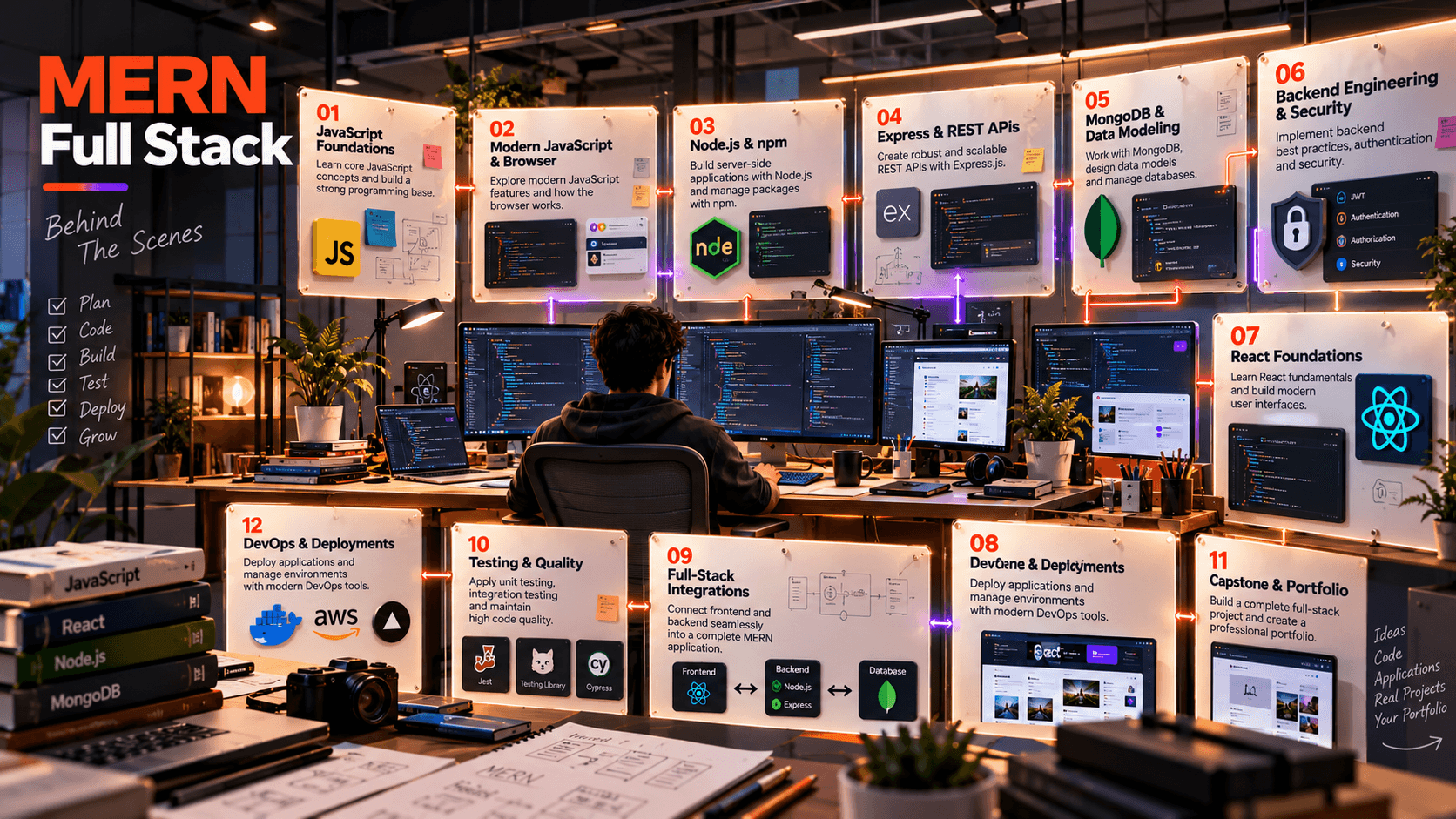
MERN Full Stack is proposed as a 60-day, project-led web development program built around MongoDB, Express.js, React and Node.js. The pathway should take learners from JavaScript fundamentals through backend development, database integration, API design, authentication, frontend engineering, testing, deployment and a complete full-stack capstone.
The recommended architecture keeps JavaScript/modern TypeScript-aware web concepts at the center while using Node.js for server-side execution, Express.js for backend/API structure, MongoDB for document-oriented persistence, and React for the frontend. Git, automated testing, Docker and CI/CD are introduced as engineering practices rather than optional add-ons.
The course should be positioned around one connected workflow: UI → API → business logic → database → response → testing → deployment. Each phase should produce a practical artifact that becomes part of the final application.
03 //Curriculum
Course phases.
04 //Technology stack
The tools you'll work with.
Language
Core programming language
Modern JavaScript (ES6+)
Runtime
Server-side JavaScript execution
Node.js
Package manager
Dependencies and scripts
npm
Backend
Web server and REST APIs
Express.js
Database
Document-oriented persistence
MongoDB
Database tooling
Application data access and modeling
MongoDB driver / approved ODM
Frontend
Component-based web UI
React
Routing
Client-side navigation
React Router or approved equivalent
API
Frontend/backend integration
REST + JSON
Testing
Automated quality checks
Jest or Vitest + API/E2E tooling
Version control
Collaboration and portfolio
Git + GitHub
Containers
Portable application packaging
Docker
CI/CD
Automated build/test workflows
GitHub Actions or equivalent
05 //Projects and practice
Learning by doing.
- 01
Expense Tracker
JavaScript, arrays, objects, functions, DOM
- 02
Interactive Task Dashboard
DOM, events, async JavaScript, API calls
- 03
CLI/API Utility
Node.js, modules, npm, async programming
- 04
Business REST API
Express, routing, middleware, validation
- 05
Inventory/Contact API
MongoDB CRUD, indexes, data modeling
- 06
Secure User API
Authentication, authorization, protected routes
- 07
Operations Dashboard
React components, state, routing, forms
- 08
Full-Stack Business Module
React + Express + MongoDB
- 09
Containerized MERN App
Git, Docker, CI
- 10
Enterprise-Style MERN Platform
End-to-end architecture and delivery
06 //Capstone
Capstone options.
- 01
Business CRM Platform
Users, leads, contacts, pipeline stages, tasks, dashboards, search and reporting.
- 02
Learning Management Platform
Users, courses, modules, assessments, progress tracking, roles and dashboards.
- 03
E-Commerce Platform
Products, users, cart, orders, inventory, admin workflows and secure APIs.
- 04
Service Booking Platform
Customers, providers, availability, bookings, notifications and administration.
- 05
Project Management Platform
Workspaces, projects, tasks, permissions, comments, activity tracking and dashboards.
07 //Assessment
How progress is checked.
- Daily JavaScript coding exercises.
- Weekly practical checkpoints.
- Phase-end mini-projects.
- Node/Express API assignments.
- MongoDB data-modeling exercises.
- React UI and full-stack integration assessments.
- Security and validation checkpoints.
- Git/Docker/CI workflow assessment.
- Final capstone architecture, implementation, testing and presentation review.
08 //Learning journey
From foundation to capability.
How learning builds through a course. It describes the approach, not a promised outcome.
Foundation to capability
How learning builds
Stage 01
Foundation
The core concepts, vocabulary and tools the rest of the course builds on.
Stage 02
Practice
Guided exercises that turn concepts into working skills.
Stage 03
Application
Applying those skills to realistic problems and project work.
Stage 04
Capability
Using what you've learned with growing independence and judgement.
09 //Questions
Frequently asked questions.
Start learning
Ready to start learning?
Ask about training to talk through where this course fits your goals.