
01 //Training course
MYSQL DBA
- Track
- Data & Analytics
- Duration
- 30 Days
02 //Why this course
Why this course.
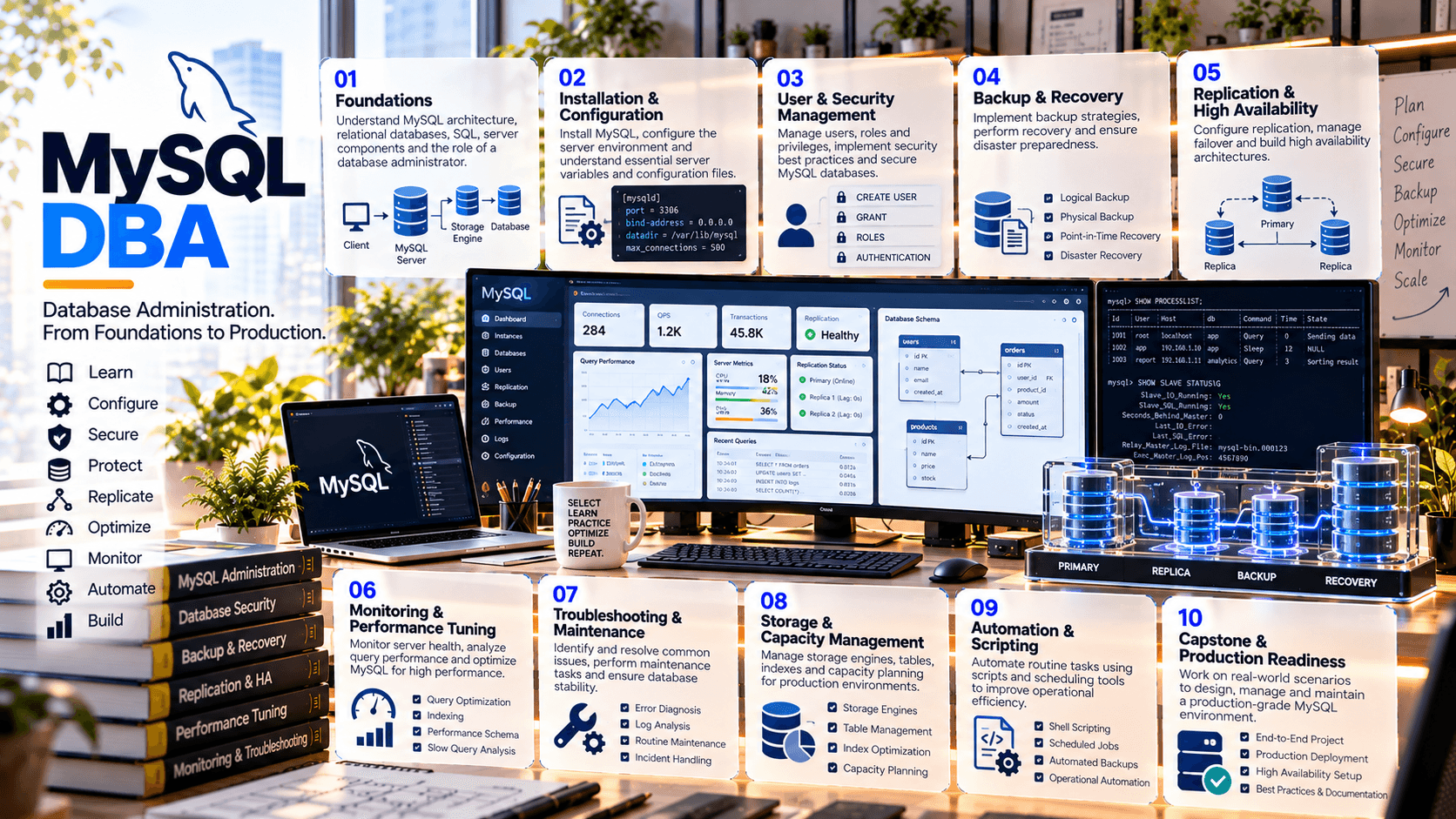
This 30-day program is designed as a practical MySQL database administration pathway covering server architecture, installation/configuration, accounts and privileges, InnoDB, backup and recovery, replication, monitoring, performance tuning, troubleshooting and high-availability concepts. The architecture treats the DBA role as an operational discipline: establish a reliable server, secure access, protect data, monitor workload, diagnose incidents, optimize queries and design resilient topologies.
MySQL 8.4 documentation identifies InnoDB as the default storage engine and documents ACID transactions, row-level locking, recovery, indexes and foreign keys. Current MySQL documentation also provides dedicated administration areas for backup/recovery, replication, security, Performance Schema, optimization, MySQL Shell and InnoDB Cluster.
03 //Curriculum
Course phases.
04 //Technology stack
The tools you'll work with.
Tools
MySQL 8.4 LTS
MySQL Server
MySQL Client / mysql command-line client
MySQL Workbench
MySQL Shell
MySQL AdminAPI
InnoDB
Performance Schema
sys schema
Binary logging / GTID replication
mysqldump and official backup/recovery concepts
MySQL Router / InnoDB Cluster concepts
Linux shell and service-management fundamentals
Git / GitHub for runbooks and configuration documentation
Docker for isolated training labsOptional
05 //Projects and practice
Learning by doing.
- 01
MySQL Server Administration Lab
Install/configure a MySQL instance, create databases, tune basic variables and produce an administration checklist.
- 02
Secure Database Environment
Create users/roles, implement least-privilege access, configure secure connections and document the privilege model.
- 03
InnoDB Transaction Lab
Demonstrate transactions, isolation, locking and deadlock troubleshooting using controlled concurrent sessions.
- 04
Backup & Recovery Drill
Create a backup strategy, perform a restore and demonstrate point-in-time recovery in an authorized lab.
- 05
Replication Lab
Configure source/replica replication, monitor status and troubleshoot replication lag or a controlled failure.
- 06
Performance Investigation
Use EXPLAIN/EXPLAIN ANALYZE, indexes, statistics and Performance Schema to diagnose a slow workload.
- 07
HA Architecture Lab
Design an InnoDB Cluster/Router architecture and document failover behavior; exact hands-on scope depends on lab resources.
- 08
Production Operations Runbook
Combine monitoring, backup, security, replication, incident response and recovery into a DBA operations handbook.
06 //Capstone
Capstone options.
- 01
E-Commerce MySQL Production Platform
secure database, optimized schema, backup/recovery, replication and monitoring.
- 02
Banking-Style Transaction System
InnoDB transactions, isolation, locking, security and recovery-focused administration.
- 03
Analytics Read-Replica Architecture
source/replica topology, GTIDs, monitoring, query workload separation and backup use.
- 04
High-Availability MySQL Blueprint
InnoDB Cluster, Router, failover, security, backups and operational runbooks.
- 05
DBA Incident Response Center
simulated failures across performance, replication, access, backup and storage with evidence-based RCA.
07 //Assessment
How progress is checked.
- DBA concepts & quizzes
- Installation/configuration/security labs
- InnoDB/transaction labs
- Backup/recovery & replication labs
- Performance/monitoring troubleshooting
- HA / MySQL Shell exercise
- Integrated capstone
- Technical runbook presentation
08 //Learning journey
From foundation to capability.
How learning builds through a course. It describes the approach, not a promised outcome.
Foundation to capability
How learning builds
Stage 01
Foundation
The core concepts, vocabulary and tools the rest of the course builds on.
Stage 02
Practice
Guided exercises that turn concepts into working skills.
Stage 03
Application
Applying those skills to realistic problems and project work.
Stage 04
Capability
Using what you've learned with growing independence and judgement.
09 //Questions
Frequently asked questions.
Start learning
Ready to start learning?
Ask about training to talk through where this course fits your goals.