
01 //Training course
Prompt Engineering
- Track
- AI & Emerging Technologies
- Duration
- 45 Days
02 //Why this course
Why this course.
Prompt Engineering is proposed as a 45-day, hands-on program focused on designing, testing and improving instructions for modern AI models. The course should move beyond isolated prompt tricks and teach a repeatable engineering discipline: define the task → provide the right context → constrain the output → test variations → evaluate results → iterate → integrate the prompt into a reusable workflow.
The curriculum should cover foundational prompting, structured outputs, few-shot examples, role and context design, prompt decomposition, reasoning-oriented task design, tool/function calling concepts, retrieval-augmented prompting, multimodal prompts, evaluation, prompt security, reusable prompt systems and production-oriented workflows.
The course should explicitly distinguish prompting from broader AI application engineering. A prompt can improve model behavior, but reliable systems also depend on model selection, context quality, retrieval, tools, evaluation, application logic, security and human oversight.
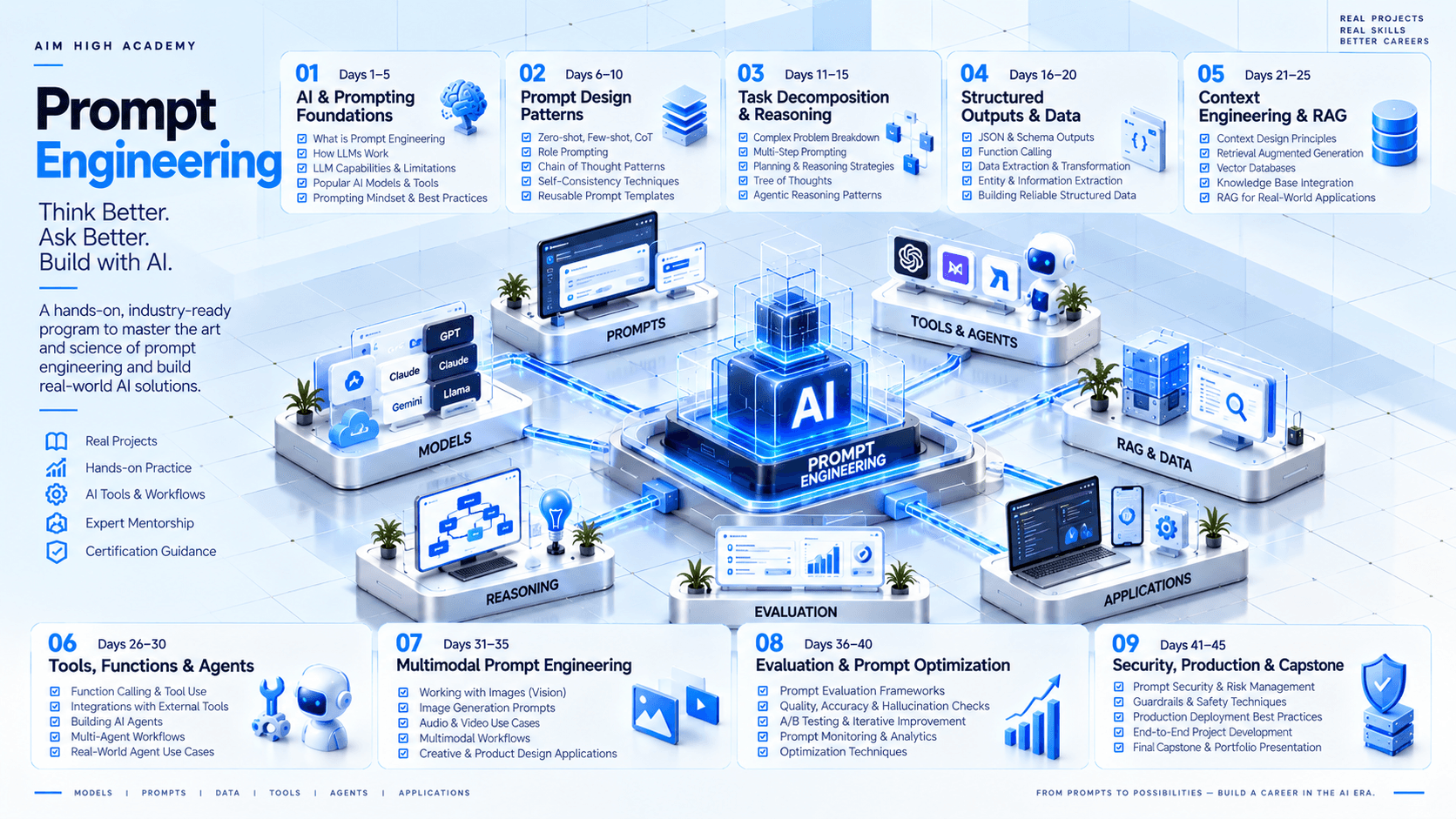
03 //Curriculum
Course phases.
04 //Technology stack
The tools you'll work with.
LLM platforms
Prompt experimentation and model comparison
OpenAI API / ChatGPT or equivalent approved model platforms
Prompt interface
Rapid iteration and testing
Chat-based AI workspaces + API playgrounds
Programming
Prompt automation and application integration
Python
Structured output
Reliable machine-readable outputs
JSON Schema / Pydantic concepts
APIs
Tool and application integration
REST APIs + SDKs
Retrieval
Grounded prompting and RAG
Embeddings + vector database concepts
Frameworks
Prompt and agent orchestration
LangChain/LangGraph or equivalent workflow frameworks
Evaluation
Prompt quality measurement
Custom test sets + LLM/human evaluation
Version control
Prompt/version management
Git/GitHub
Data
Prompt experiments and benchmarks
CSV/JSON/text/document datasets
Observability
Debugging and production monitoring
Logs, traces and prompt/version metadata
Documentation
Prompt cards and engineering documentation
Markdown/Notion/equivalent
05 //Projects and practice
Learning by doing.
- 01
Prompt Pattern Library
Zero-shot, few-shot, roles, constraints and templates
- 02
AI Research Assistant
Source-aware research, summarization and evidence handling
- 03
Content Generation System
Brand voice, structured outputs, rewriting and quality control
- 04
Structured Extraction Pipeline
JSON/schema outputs, extraction, classification and validation
- 05
Document QA Assistant
Context engineering, retrieval and grounded responses
- 06
API Tool-Calling Assistant
Tool descriptions, arguments, selection and error handling
- 07
Document/Image Analysis Workflow
Visual/document prompting and structured extraction
- 08
Prompt Benchmark Suite
Test data, rubrics, comparison and regression
- 09
Prompt Security Lab
Injection awareness, instruction conflicts and data protection
- 10
Production Prompt System
Prompt library + workflow + evaluation + documentation
06 //Capstone
Capstone options.
- 01
AI Research Assistant
Design a research workflow that retrieves source material, summarizes findings, structures evidence and produces a reviewable report.
- 02
Customer Support Prompt System
Build prompts for intent classification, response drafting, escalation and structured support outputs.
- 03
Document Intelligence Workflow
Extract fields from documents, validate structured outputs and route exceptions for human review.
- 04
Marketing Content Engine
Create a reusable brand-aware system for briefs, social content, email, ad copy and repurposing.
- 05
Data Analysis Copilot
Design prompts that transform structured data into analysis, summaries and decision-ready outputs.
- 06
Tool-Using AI Assistant
Build a controlled workflow where the model selects tools, passes structured arguments and evaluates results.
07 //Assessment
How progress is checked.
- Daily prompt experiments and output comparisons.
- Weekly prompt-pattern assignments.
- Prompt debugging and failure-analysis exercises.
- Structured-output implementation tasks.
- RAG/context-grounding exercise.
- Tool/function-calling workflow exercise.
- Multimodal prompt assessment.
- Prompt benchmark and evaluation-suite assignment.
- Prompt security and injection-awareness assessment.
- Final capstone architecture, implementation, testing and presentation.
08 //Learning journey
From foundation to capability.
How learning builds through a course. It describes the approach, not a promised outcome.
Foundation to capability
How learning builds
Stage 01
Foundation
The core concepts, vocabulary and tools the rest of the course builds on.
Stage 02
Practice
Guided exercises that turn concepts into working skills.
Stage 03
Application
Applying those skills to realistic problems and project work.
Stage 04
Capability
Using what you've learned with growing independence and judgement.
09 //Questions
Frequently asked questions.
Start learning
Ready to start learning?
Ask about training to talk through where this course fits your goals.