
01 //Training course
Salesforce
- Track
- Enterprise Technologies
- Duration
- 45 Days
02 //Why this course
Why this course.
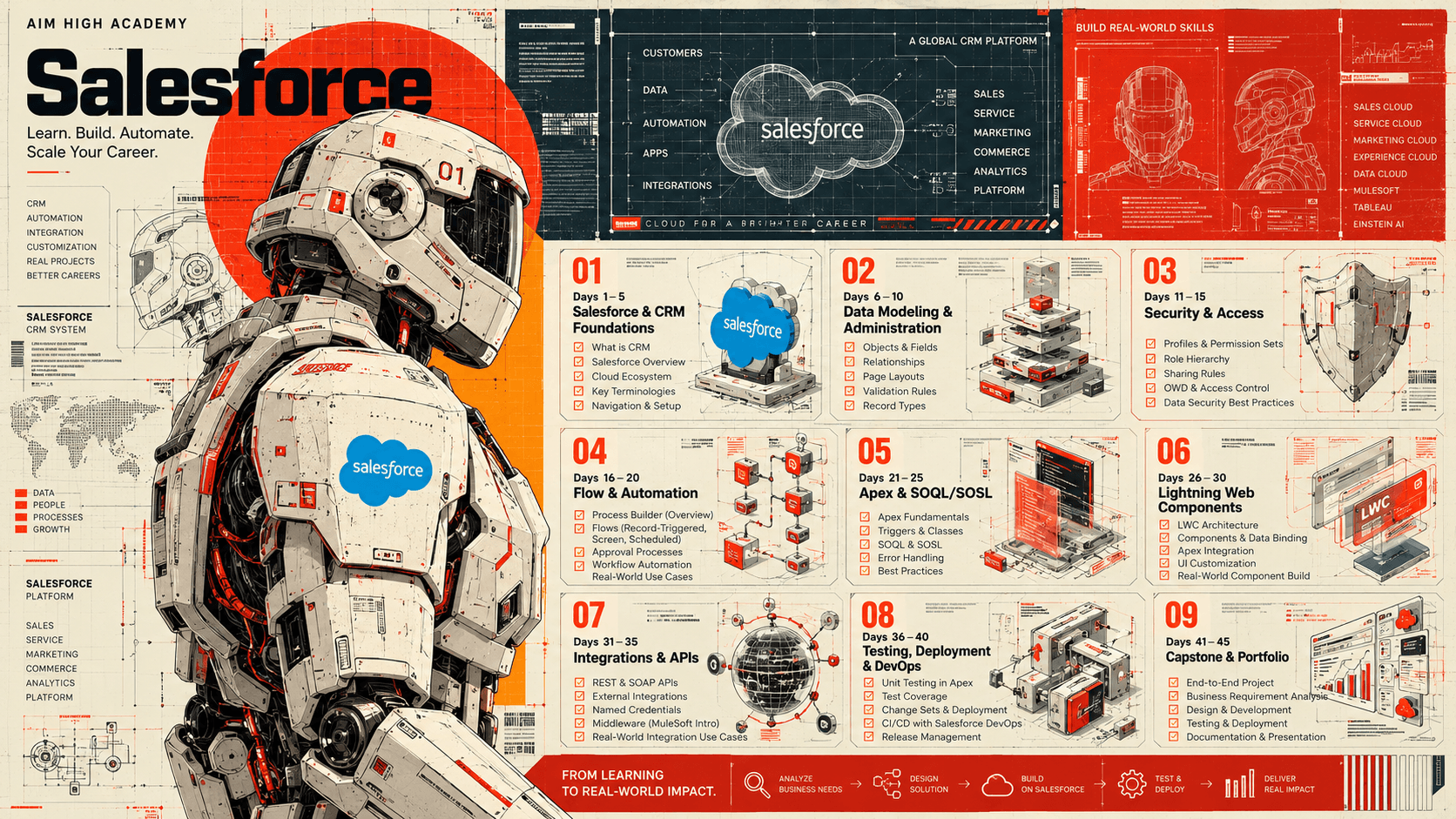
Salesforce is proposed as a 45-day, project-led CRM and cloud-platform program covering CRM fundamentals, Salesforce platform architecture, data modeling, security, automation, Flow, Apex, Lightning Web Components, integrations, testing, deployment and practical administration/development workflows.
Because Salesforce supports multiple professional paths, the recommended 45-day architecture should deliberately combine an administrator foundation with developer-oriented skills. Learners first understand objects, relationships, permissions and declarative automation, then progress into Flow, Apex, SOQL/SOSL, Lightning Web Components, APIs and deployment.
The course should be positioned around a complete CRM solution lifecycle: understand the business process → model data → configure security → automate → develop custom functionality → integrate → test → deploy → document.
03 //Curriculum
Course phases.
04 //Technology stack
The tools you'll work with.
CRM platform
Core CRM and application platform
Salesforce Platform
Administration
Org configuration and management
Salesforce Setup / configuration tools
Data model
Business data architecture
Objects, fields, relationships
Automation
Declarative workflow automation
Flow Builder
Programming
Custom server-side logic
Apex
Query
Data retrieval and search
SOQL + SOSL
Frontend
Custom Salesforce UI
Lightning Web Components
Integration
External system connectivity
REST/SOAP APIs + Apex callouts
Testing
Quality validation
Apex tests + functional/UAT concepts
Source control
Source-driven development
Git + Salesforce DX/CLI concepts
Deployment
Environment promotion
Metadata/source deployment workflows
Monitoring
Troubleshooting and operations
Debug logs / platform monitoring concepts
05 //Projects and practice
Learning by doing.
- 01
Lead Management CRM
Objects, records, views and basic CRM workflows
- 02
Sales Pipeline Model
Relationships, validation, data quality and reports
- 03
Role-Based CRM Access
Users, permissions, sharing and access controls
- 04
Lead-to-Opportunity Workflow
Flow, decisions, assignments and notifications
- 05
Custom Business Rules
Apex classes, SOQL, triggers and bulkification
- 06
Sales Dashboard Component
LWC, data access, events and UI
- 07
External Data Sync
REST/SOAP concepts, callouts and error handling
- 08
Release Workflow
Git/source concepts, tests and deployment
- 09
End-to-End Salesforce CRM
Data + security + automation + Apex + LWC + integration
06 //Capstone
Capstone options.
- 01
Sales CRM Transformation
Leads, opportunities, accounts, contacts, pipeline automation, dashboards, security and custom UI.
- 02
Service Management Platform
Cases, queues, service workflows, escalation automation, permissions and agent experience.
- 03
Recruitment CRM
Candidates, employers, applications, stages, automated notifications, reports and custom components.
- 04
Education CRM
Students, programs, enquiries, admissions, workflows, dashboards and role-based access.
- 05
Customer Onboarding Platform
Customer records, verification workflow, approvals, automation, integration and reporting.
07 //Assessment
How progress is checked.
- Daily Salesforce configuration exercises.
- Weekly data-modeling and automation tasks.
- Flow Builder practical assessments.
- SOQL/SOSL and Apex coding assignments.
- LWC component implementation tasks.
- Security/access review exercises.
- API integration exercises.
- Apex testing and debugging checkpoints.
- Deployment/release assessment.
- Final capstone architecture, implementation, testing and presentation review.
08 //Learning journey
From foundation to capability.
How learning builds through a course. It describes the approach, not a promised outcome.
Foundation to capability
How learning builds
Stage 01
Foundation
The core concepts, vocabulary and tools the rest of the course builds on.
Stage 02
Practice
Guided exercises that turn concepts into working skills.
Stage 03
Application
Applying those skills to realistic problems and project work.
Stage 04
Capability
Using what you've learned with growing independence and judgement.
09 //Questions
Frequently asked questions.
Start learning
Ready to start learning?
Ask about training to talk through where this course fits your goals.