
01 //Training course
Scrum Master
- Track
- Professional & Career Skills
- Duration
- 12 Days
02 //Why this course
Why this course.
This 12-day program is designed as an intensive, practice-led Scrum Master pathway. It moves from Scrum theory and empiricism into the framework, accountabilities, events, artifacts, Definition of Done, Product Backlog management, facilitation, coaching, team dynamics, impediment removal, stakeholder collaboration, metrics and organizational agility.
The Scrum Guide defines the Scrum Master as accountable for establishing Scrum and for the Scrum Team's effectiveness, with service to the team including coaching self-management and cross-functionality, helping the team focus on valuable Increments, causing impediment removal, and ensuring Scrum events are productive and timeboxed.
Current Scrum.org Professional Scrum Master learning descriptions emphasize Scrum theory, empiricism, Scrum values, the framework, Definition of Done, Product Backlog, self-managing teams, interpersonal skills, the Scrum Master role and practical team-based exercises.
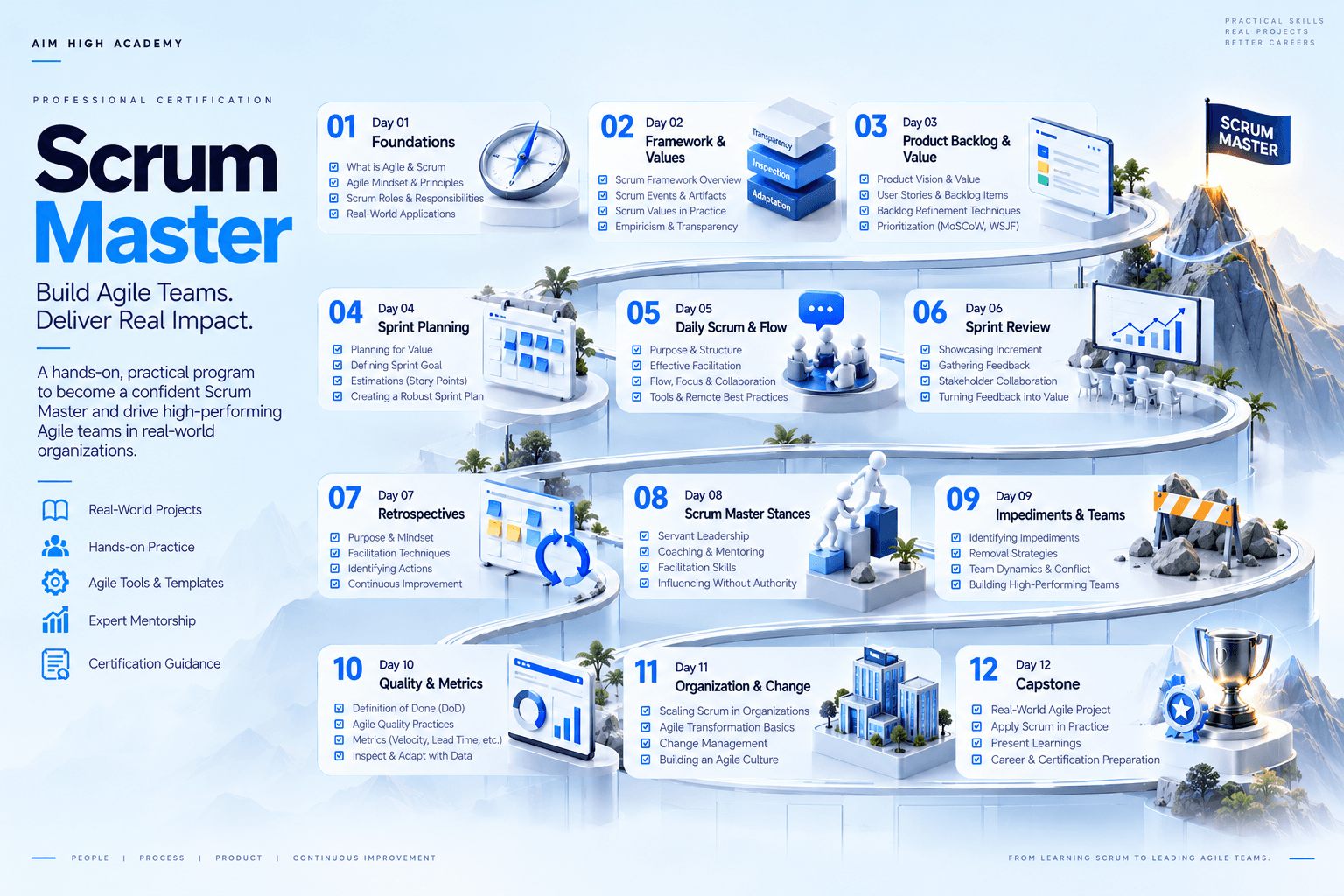
03 //Curriculum
Course phases.
04 //Technology stack
The tools you'll work with.
Tools
Jira Software or an equivalent backlog/Sprint management platform
Confluence or equivalent team documentation/wiki platform
Miro, FigJam or equivalent collaborative whiteboard
Azure DevOps Boards as an optional enterprise workflow environment
Google Sheets / Excel for lightweight metrics exercises
GitHub Projects or equivalent for a developer-oriented Scrum simulation
Video collaboration platform for remote facilitation practice
Survey/form tool for retrospective and stakeholder feedback exercises
Notes
Tool selection is implementation guidance, not a requirement of Scrum itself. The framework does not prescribe a particular project-management platform.
05 //Projects and practice
Learning by doing.
- 01
Scrum Team Simulation
Create a product vision, Product Goal, initial Product Backlog and working agreements for a simulated product.
- 02
Backlog Workshop
Transform stakeholder needs into clear Product Backlog items, order them around value and prepare a Sprint-ready slice.
- 03
Sprint Planning Lab
Facilitate a Sprint Planning session and produce a Sprint Goal plus an initial plan for delivering the Increment.
- 04
Daily Scrum Facilitation
Run multiple Daily Scrum scenarios, identify impediments and demonstrate adaptation toward the Sprint Goal.
- 05
Stakeholder Review Lab
Facilitate a Sprint Review with changing stakeholder feedback and adapt the Product Backlog based on evidence.
- 06
Retrospective Lab
Run retrospectives using multiple techniques and convert findings into measurable improvement experiments.
- 07
Coaching & Conflict Simulation
Respond to team conflict, dependency issues, low participation and command-and-control behaviors using appropriate Scrum Master stances.
- 08
Integrated Scrum Capstone
Operate a complete simulated Scrum Team across a mini-Sprint and present evidence of facilitation, coaching, impediment handling and continuous improvement.
06 //Capstone
Capstone options.
- 01
Digital Product Scrum Simulation
guide a team from Product Goal through Sprint Review and Retrospective.
- 02
Enterprise Transformation Scenario
diagnose organizational impediments and propose a Scrum adoption/improvement roadmap.
- 03
AI Product Delivery Simulation
manage uncertainty, changing stakeholder feedback and evolving backlog priorities.
- 04
Customer Platform Sprint Lab
demonstrate value slicing, Sprint Goal design, facilitation and feedback-driven adaptation.
- 05
Scrum Master Incident Room
respond to conflicting priorities, blocked work, quality issues, stakeholder pressure and team conflict.
07 //Assessment
How progress is checked.
- Scrum theory & framework assessment
- Backlog / Sprint Planning lab
- Daily Scrum facilitation
- Sprint Review facilitation
- Retrospective facilitation
- Coaching / impediment scenario
- Metrics & improvement exercise
- Integrated Scrum capstone
- Reflection & professional portfolio
08 //Learning journey
From foundation to capability.
How learning builds through a course. It describes the approach, not a promised outcome.
Foundation to capability
How learning builds
Stage 01
Foundation
The core concepts, vocabulary and tools the rest of the course builds on.
Stage 02
Practice
Guided exercises that turn concepts into working skills.
Stage 03
Application
Applying those skills to realistic problems and project work.
Stage 04
Capability
Using what you've learned with growing independence and judgement.
09 //Questions
Frequently asked questions.
Start learning
Ready to start learning?
Ask about training to talk through where this course fits your goals.